Showing posts with label rant. Show all posts

Thursday, March 30, 2017

Rollback of the Fiduciary Rule

For those keeping track, back on February 3rd, Trump signed an execute of order targeting the Dodd-Frank Act, the tepid financial reform passed to try and prevent a repeat of the 2008 financial crisis and its trillion dollar bail-out of Wall Street.

The lady in green seems very pleased. That's Representative Ann Wagner, Republican of Missouri's 2nd district, who called rolling back the fiduciary rule “a labor of love for me.” Coincidentally, donors with names like Jones Financial Companies, Northwestern Mutual, Wells Fargo, Financial Services Institute PAC showed Wagner a lot of love in the form of campaign funds.

Thursday, December 6, 2012

Three Myths about Copyright Law

Just to prove that Lawrence Lessig is right, a GOP group released a shockingly sensible memo on copyright, then retracted it due to pressure from lobbyists. Now Derek Khanna, the staffer that wrote it has been given the boot.

Khanna’s three myths

  • the purpose of copyright is to compensate the creator of content
  • copyright is free market capitalism at work
  • the current copyright legal regime leads to the greatest innovation and productivity

To read

More on intellectual property

Saturday, November 24, 2012

Persuasion, Initiative, Freedom, Desire

Econ 101 leaves out persuasion. What fraction of business (/politics) is persuasion? ... It's rare for people to initiate their own dreams or be 100% originators of their goals or preferences. ... Which presents a problem for the Edgeworth-box story of lonely individuals trading with each other. ... pleasure and preference themselves are malleable and being moulded by others all the time. ... Even besides "marketing types" ... plenty of people reflexively enforce social norms and expectations.
The story of Don Draper and the Lucky Strikes makes us individuals out not as free-willed inventors of ourselves, util-seekers and comandantes of our own pocketbooks--but as dull voids with no idea what to do with the incomprehensible freedom we enjoy in a society where incomes so far exceed subsistence. ... It puts us as templates onto which meme-smiths paint their work, searching for 1 that will stick and replicate itself.
...the suggestions of what to do with freedom--trips to India, faling madly in love, "On The Road" type life--aren't original ideas, those come from stories which we have no better idea than to live out.
It's somewhere in that spirit, I think, that persuasion in the workplace, in the store, on the TV, can be modelled. And without an effective theory of persuasion I don't see how economic theory can take an honest accounting of choice, preference, or "optimum".

Isomorphismes, see things differently

Sunday, December 18, 2011

Stop SOPA

In a matter of days, it looks likely that congress will pass SOPA (the Stop Online Piracy Act), another gift to special interest groups from motion picture and recording industry.

The bill targets sites like Sweden's The Pirate Bay, Hong Kong based MegaUpload or the Dutch site TorrentFreak requiring search engines, discussion forums, blogs and DNS providers to censor access to these types of sites prompting comparisons to China's great firewall.

The technical cluelessness on display in the congressional hearings is embarrassing, but, really, who expects anything different? Leading engineers have petitioned in opposition on the grounds that this legislation imposes serious burdens on infrastructure providers and probably won't even work.

How big a problem is this?

Technical issues aside, we should recognize that bootlegging movies or music is a fairly low-cost crime as far as society is concerned. Comparing it with illegal drugs, as The Economist does, is a joke when you think about lives wrecked by meth or crack or the ongoing drug war in Mexico. Piracy seems pretty benign next to the consequences of financial malfeasance in recent years, but now we're talking radical crazy talk.

The biggest consequence of piracy is that an artificial monopoly is less lucrative than it would otherwise be. Legal monopolies have a long history of abuse. They're a great way for politicians to give out favors and ask favors in return. In a textbook specimen of double-speak, any recognition of this economic and political reality is called sympathetic to piracy, something like being called a pinko in the McCarthy era.

A couple definitions

Rivalry is an economic concept describing whether the use of a good by one party precludes its use by another. The distinction being made here means that a million people could listen to Lady Gaga's latest tune at the same time. A million people could not ride in my car or live in my house. My house and car are rival goods. Songs are non-rival.

For every copyrighted work not pirated, how many would be purchased? My guess is that this ratio is low. I'm pretty sure nobody has convincingly shown otherwise. For the items not purchased, the utility of consuming them is lost, with no corresponding gain to the monopolist. This is called a dead weight loss, meaning some people could be made better off without making anyone else worse off, but we fail to do it. This loss is the music/movies/etc that wouldn't be enjoyed if they weren't pirated.

Willful ignorance of these simple but important ideas bugs me a lot more than bozo-grade technical knowledge.

Which is worse, the problem or the solution?

Now, it's important that creators of valuable intellectual property make a decent living. Few question that. What we're talking about is whether publishers should put up toll booths on the road between the consumer and the producer, and whether the government should enforce the use of these toll roads, when technology has made such choke points obsolete. Since distribution is now practically free, is it a good idea to create costly and ultimately ineffective legal barriers to replace the physical barrier that no longer exists?

Let's total up the costs. There's dead weight loss. There's a loss to innovation and culture which suffer when the interchange of ideas is impeded. There's the technical costs of implementing measures like SOPA, (and DRM and copy-protection before it), which tend to fall on paying customers.

To be fair, a partially market based means of valuing intellectual property and rewarding its creation is not to be dismissed lightly. Blocking access to download sites will result in some revenue trickling down to deserving artists. Too bad, no one speaks about the issue in terms of balancing benefits against costs.

The real problem

[The nightmarish SOPA hearings By Alexandra Petri, Washington Post]

It's shameful that congress is so eager to shill for corporations and their lobbyists rather than protect the interests of the people they are elected to serve.

Update:SOPA and it's sister PIPA (the PROTECT IP Act) have been temporarily shelved, thanks to an enormous public outcry and the opposition of Oregon Senator Ron Wyden. Clay Shirky sums it up, like so:

We should delight in the stand we’ve taken in favor of things like, say, notifications, and trials, and proof before censoring someone, but we should get ready to do it again next year, and the year after that. The risk now is not that SOPA will pass. The risk is that we’ll think we’ve won. We haven’t; they’ll be back. Get ready to have this fight again.

Monday, August 1, 2011

Making the patent system even worse

The economist explains the state of the US patent system like this:

At a time when our future affluence depends so heavily on innovation, we have drifted toward a patent regime that not only fails to fulfill its justifying function, to incentivise innovation, but actively impedes innovation. We rarely directly confront the effects of this immense waste of resources and brainpower and the attendant retardation of the pace of discovery, but it affect us all the same. It makes us all poorer and helps keep us stuck in the great stagnation.

Congress is in the process of passing a "first-to-file system". It's hard to see this as anything but a gift to big corporations. Writing in Foreign Policy, Clyde Prestowitz calls the Americans Invent act, "...a bill likely to cut the heart out of our innovative, entrepreneurial culture...". Even the pro-patent group American Innovators for patent reform says,

American Innovators for Patent Reform is opposed to the America Invents Act and we urge the House of Representatives to draft an entirely new law that truly addresses what needs to be reformed. The America Invents Act was crafted by lobbyists for the large corporations that are notorious infringers of patents!

...and...

Canada made the switch to first-to-file in 1989, and a 2009 study from researchers at Canada’s McGill University’s Department of Economics found that the change “failed to stimulate Canadian R&D efforts” and “skewed the ownership structure of patented inventions towards large corporations, away from independent inventors and small businesses.

It looks like the US patent system is about to become even more screwed up.

Nice work as usual, congress.

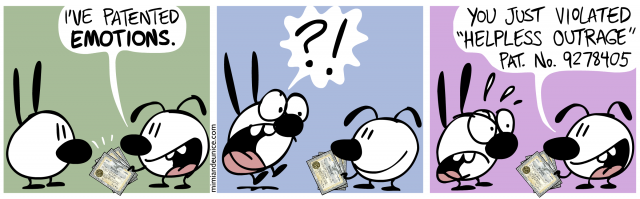
BTW, Mimi & Eunice is a work of genius

More links

Wednesday, September 1, 2010

Let the Bush tax cuts expire

Has the Wall Street Journal gone totally right wing nutballs or has it always been that way? A recent article on the expiration of the Bush tax cuts gives cause for concern.

In the summer of 2007, Rupert Murdoch prevailed upon the Bancroft family and sucked the WSJ into the media empire of News Corp. Murdoch's other properties include Fox News and the New York Post, neither of which are exactly monuments to journalistic integrity. As a very occasional reader, I can't say whether or how much the WSJ has changed since.

In the weekend edition of August 28, 2010 an unsigned editorial titled The $31 Billion Revenue Fantasy complains about the plan to let the Bush tax cuts expire. They make the claim that the Bush tax cuts were not a windfall for the rich. After the particularly piercing argument "Yada, yada, yada," (really, they said that), they throw up a bunch of numbers. It's not that surprising to find a sermon to the anti-tax faithful in the WSJ. But, the totally bogus and deceptive line of argument they use has a real Fox News ring to it. For example:

The IRS data show that in 2003 those with incomes above $200,000 paid $313 billion in income tax. By 2007 they paid $610 billion. When the recession hit, the payments fell to $537 billion in 2008. But even accounting for that decline, payments by the rich were still 65% higher five years after the rate cut that was supposedly a giveaway to the rich. The share of federal income taxes paid by the $200,000-a-year club was 42% in 2003 but 52% in 2008. (The IRS doesn't adjust these annual numbers for inflation.)

Inflation is only one reason why these numbers are not very meaningful. According to CPI numbers, 100 2003-dollars is about 117 2008 dollars. So, even if incomes only track inflation the pool of 200k-plus tax-payers grew. Also at the same time, the economy was expanding (and bubbles growing in housing and finance), which also lifts people into the higher income bracket. Tax receipts at all levels go up with the economy. Tax receipts from higher brackets go up more. Finally, high-income earners (for example those already over the 200k line) saw their incomes increase at a rate greater than the economy as a whole, thus paying more taxes.

These numbers are completely consistent with the story that the rich got richer while being taxed at a lower rate. As the New York Times put it:

Though tax cuts for the rich were bigger than those for other groups, the wealthiest families paid a bigger share of total taxes. That is because their incomes have climbed far more rapidly, and the gap between rich and poor has widened in the last several years.

- NYT “Tax Cuts Offer Most for Very Rich”

In 2003, 450 economists signed a statement (Economists’ statement opposing the Bush tax cuts (2003)) opposing the Bush tax cuts on the grounds that they would fail as a growth stimulus, increase inequality and worsen the budget outlook. Even Alan Greenspan thinks these tax cuts should expire as do former Treasury Secretaries Robert Rubin and Paul O'Neill.

The real question the editorial is trying to address is what degree of progressivity do we want in our tax system. Should those who have benefited most, in turn, support the system most? That's a fair and legitimate question. As economist Russ Roberts puts it, “Should we be more like France or less like France?”

What disappoints me about the WSJ article is this: Shouldn't the readers of the WSJ - educated businessmen, rather than tea-party loonies - be able to think this through soberly and logically? Given the audience of the WSJ, we're left with the scary conclusion that many of the wealthy are lying to themselves to justify their own sense of entitlement. Either that, or they're trying to arm themselves with deceitful and self-serving arguments to manipulate those less savvy than themselves.

There are common features to be found in several species of voodoo economics from the Laffer curve and trickle-down economics to "starving the beast" to the claim that letting the Bush tax cuts expire would stifle the recovery. Numerical quackery obscures policy that always seems to favor the rich at the expense of the common good.

What about what's good for the country? Shouldn't the country's business elites have a few ounces of patriotic blood in their veins? And might that lead to pursuit of goals that are good for America as a whole; strategies that grow the pie for everyone rather than tactics for capturing an ever bigger slice?

Related stuff

Sunday, November 1, 2009

Healthcare pragmatics

The debate on healthcare reform is practically over and the important points haven't even broken the surface of the public debate. Have we dumbed ourselves down to the point where we can no longer publicly talk through an issue? So it seems. Well, here's an attempt to state the obvious, which will put me ahead of most news media and way ahead of both political parties.

  • Healthcare costs money. Someone has to pay. Different schemes distribute the cost and benefits slightly differently at the margin. But, under any plan from government run single-payer to pure pay-as-you-go, roughly the same people are going to pay. For all the ideological histrionics, you and I, middle-class america, are going to pay no matter what. We'll get middle-class healthcare for ourselves and subsidize healthcare for the poor. This arrangement won't change much whatever reform happens or doesn't happen. The amount of subsidy coming from the executive class healthcare of the rich varies a bit from one scheme to another. Different segments of the poor or working poor are better off under some plans. But, for the most part the poor have no money and the rich have accountants and lawyers, so the middle class has to pay.
  • Healthcare is a public good. For several reasons, I have an interest in your health. For example, if you could refrain from coughing any H1N1 on my lunch, I'd appreciate it. I depend on my coworkers, local businesses, and my community. If those people are out sick, or worse yet, out in public spreading viruses, I suffer. So, am I willing to contribute to your healthcare? A rational person should say, "yes".
  • The benefit of insurance comes from pooling risk. Middle-men cost money. In the case of insurance, we accept the cost of the middle-men because they help us by redistributing risk. If we let insurance companies choose to insure only the healthy, we lose this benefit. Likewise, if we let people wait until they're sick to buy insurance. The employer-based insurance system is stable, despite making the work-force less efficient, because it effectively limits how much either side can game the system. Any system that replaces employer-based groups needs to have the same property. In the current setup, insurance also plays a redistributive role in monetary (rather than risk) terms. For example, if I have a baby, the cost of the birth is subsidized by the non-parents in my company. I subsidize the cost of insuring those with less healthy diets than mine. The young subsidize the old. Overall, it's reasonable for us, as the buyers of insurance, to ask how much this service is costing us and what kind of value we're getting.
  • People respond to incentives. Distorted incentives are all over healthcare. We're well on our way to making primary care medicine like teaching - a profession that you would do only for love because it pays so little. Already many rural areas have shortages of primary care. Also, if you threaten doctors with law suits, you get expensive (uncomfortable, potentially risky) tests. It's called CYA medicine. And, of course, those spending someone else's money tend to spend too much.
  • We're all going to die. Saudi princes with personal physicians, plebeian patients of HMOs, and tin-shack squatters with nothing all share the same fate, in the blink of an eye that is our short lives. Medicine has awesome powers and will gain much more awesome powers in the coming decades. But, the final outcome is not going to change any time soon.
  • Healthcare is not a right. Human rights, in general, mean you have the right to do for yourself unmolested by others. You do not have the right to force others to do for you. Your right to life means that nobody has the right to kill you. It does not mean you have the right to force doctors, nurses and drug companies to take care of you. Healthcare is a limited resource and it should be treated that way.
  • The current American system is very inefficient. Countries pay for healthcare in different ways. All countries struggle with healthcare, but several countries get better outcomes for a lot less than we spend. ...think we could learn something?

Monday, September 7, 2009

Keynes and Krugman

Paul Krugman writes in the NY Times about the battle currently raging in the economics profession between the fresh-water devotees of the Chicago school and the more Keynesian salt-water economists, of which he is a partisan.

"But don’t recessions look like periods in which there just isn’t enough demand to employ everyone willing to work?" Well, I sure want to work and no one will hire me. I want to work as a hammock sleeper. I'm good at it. I've trained for years. Minimum wage would be fine, even though I've got a family to feed, but no one will hire me. It's a case of inadequate demand! The government should rectify this situation at once!!

A joke? OK, but I don't want a minivan. I don't know anyone who does. They're big and ugly and burn lots of expensive fuel. Yet, the car companies are busy crying for government bailouts. But, maybe the mistake isn't inadequate demand for ugly gas guzzlers. Maybe it's inadequate ability to make cars people want. I don't see how their argument is any different than my failure to find employment sleeping in a hammock.

Guided by this neo-Keynesian thinking, the government is pumping out billions in stimulus money. My fear is the most of it will go to politically connected boondoggles, bridges to nowhere, or well intentioned but fluff-headed projects. The problem was that we as a country spent too much by taking out too much credit. We're trying to wise up and spend less and save more. That's to be encouraged.

I should read Keynes, just to know whether his work is misquoted and abused as badly as Adam Smith's. My guess is that both sides of this neo-Keynesian vs. rational-market argument contain valuable insights. But the belief that either theory is the anywhere near the whole explanation seems woefully contradicted by the facts. And arguing one dogma vs. another is a sure way to miss whatever new insights this current mess can show us.

To justify spending our way out of recession, Paul Krugman says (in the Aug. 27, 2009 NY Times) that a debt-to-GDP ratio of 70% is OK for the US. That means 1% of GDP goes to interest on the debt. He sites examples of Belgium and Italy which had debt-to-GDP ratios of 118 and 114 percent in the early 1990s. Japan's is upwards of 170%.

He says, "The United States can deal with its debts if politicians of both parties are, in the end, willing to show at least a bit of maturity." Feel safe with that assumption?

But, let's juxtapose that with the International Monetary Fund's report on Argentina's financial collapse (The IMF and Argentina, 1991-2001 By Shinji Takagi). (I don't really know if these ratios are computed the same way.)

[The] debt level of 50% of GDP was high for any country, but particularly for Argentina, given the likely overvaluation of the peso. With the sharp depreciation of the peso against the U.S. dollar, in the event, Argentina's external debt-to-GDP ratio rose to over 140% in 2002.

I don't mean to beat up on the Nobel prize winning Krugman. I like his essays and often agree with them. But the idea that more spending and more debt can possibly be the answer to a crisis brought on by too much spending and too much debt is a little hard to swallow. Maybe I'm just a grumpy old crank who thinks the world is going to hell in a hand-basket, but I'm worried that commenter, Chris Horton, might be right:

This country is toast... For my entire lifetime, the GOP have been despicable scum and the Dems worthless fools. The lights are going out all over America, we shall not see them again in our lifetime.

On a related note, Justin Fox's The Myth of the Rational Market sounds like a fun read. Krugman liked it. And EconTalk has an interview with the author.

Sunday, September 6, 2009

Capitalism on the rocks

People say that the recent financial crisis is a failure of the capitalism or even a failure of the free market. I don't agree. The real-estate bubble and the misunderstanding of the risk of derivatives, now those were market failures. The crash was a correction. People were selling snake oil. Those people went belly up. Seems to me, the market found the right answer, eventually.

Too bad, the government stepped in and bailed out the snake oil salesmen. Now they're back. Maybe they'll straighten up and fly right for a while. Maybe they'll just switch to selling another kind of snake oil. And we, the public, are a couple trillion deeper in hock.

Thursday, September 3, 2009

Efficient Market Hypothesis

The poor efficient markets hypothesis is taking a lot of flak these days. The EMH asserts that markets reflect all publicly available information. That's interpreted by some to mean that the market price is, in some sense, the right price for traded assets and, further still, that markets are rational. These days, that's looking pretty suspect, when the markets go and do something loopy like the dot-com boom, or as stark raving batshit as they've been the past couple of years.

In defense of the EMH, it's absolutely true, as long as your willing to define information to include false information, uncertain information, kooky beliefs, and outright bullshit (deliberate attempts to deceive) modulated through widely varying abilities to understand the information and act accordingly. Layer onto that the effects of the more sophisticated players trying to guess what effect the available information will have on the ill-informed and labile masses. Now you have the kind of recursive cluster-fuck that might very well produce the kind of irrational craziness that had 7-11 employees buying beachfront condos and venerable insurance companies torching themselves. The wonder is that markets are as stable as they are. "Markets can remain irrational longer than you can remain solvent."

A political economy

A recent piece in the Economist ( A new anthology of essays reconsiders Thomas Piketty’s “Capital” , May 20, 2107) ends with these words: ...