Showing posts with label US. Show all posts

Monday, December 23, 2013

The Good Life

Edmund Phelps of Columbia University, Nobel Laureate in economics, and author of Mass Flourishing appeared on EconTalk. Here's what I took away from the conversation:

Modern values and grass roots innovation

Phelps argues "that it was the birth of modern values that provided the fuel for the modern economies in Britain and America, and later maybe less fuel but nevertheless it was there in Germany and France." The manifestation of this was "grass roots innovation", propelling the rapid rises in living standards over the past two centuries.

Phelps believes that real prosperity consists of: rising wealth emerging from an individual's efforts to improve himself, work that is interesting, exercising initiative. Also, that differences in job satisfaction between countries are the result of differences in dynamism.

Phelps attributes the decline in innovation in the US since 1970 - "a narrowing of innovation to fewer industries" - to a rise of materialism, "an obsession almost with money", a rise of anti-modern values, such as conformism, and "the culture of entitlement rather than feeling that you've got to earn it yourself", along with rampant rent-seeking.

The grass roots innovation that should be going on continually has narrowed to a point where "most of the innovating that we see is that brilliant stuff going on out in Silicon Valley. And really up and down the West Coast, a fairly thin sliver of land along the West Coast."

Phelps raises the question of what kind of economy we'd want to live in, one that's more at rest and stable versus one that's more dynamic.

The Good Life

People really need to be engaged in doing things, doing rewarding things, and having the excitement of striving.
Aristotle's idea is the good life is a life that we admire in others and would like to imitate for ourselves.
In the Renaissance, people started talking about how human beings have creativity and human beings can think for themselves and should think for themselves. And people should be independent; they should have their own bank accounts and make their own living.
The good life is a life of adventure and discovery and exploration and meeting problems, overcoming hurdles. And creating. Creating stuff. For me, that's a good life. I'm sold on that.

Why might innovation cost jobs?

...to a rough approximation we can think of consumer goods as being produced mainly with capital. And capital goods are produced mainly with labor. Now, if the innovation is in the consumer goods sector, then that's driving the price of consumer goods down relative to money wages. So real wages are rising and that pulls up employment. And that's great.
But once you start having innovation in the production of the capital goods, then you've got two things going on. One, labor is physically more productive in making capital goods. But the capital goods that labor makes are now going to be cheaper, in terms of consumer goods. So that's a bummer. And that lowers real wages...

Thursday, February 28, 2013

Code for America

Jennifer Pahlka leads Code for America, which she calls something like a Teach for America or Peace Corp for geeks. The organization pairs techies, coders, designers and data wranglers with municipal governments to build apps that help connect citizens with public services and with each other.

The project starts with the premise that both technology and government are platforms for collective action. In that light, updating government's traditionally lagging approach to digital technology might have a big impact in terms of engagement with grassroots community projects.

The hope is that government can learn a few tricks from Internet and start-up culture - being permissionless and open, crowd-sourcing. Pahlka spoke at the conference Strata yesterday on helping government become more data-driven (Moneyballing Government).

Code for America seems to like trying lots of quick experimental projects to see what sticks. Some of these include:

Rebooting government

Politics may be broken beyond any individuals ability to fix. technology can lower the barrier to entry letting more people lend a hand to help the day-to-day business of government run better. In Pahlka's vision, this involves setting aside politics and contempt for bureaucracy and realizing that we are not just consumers of public services. By using our hands rather than our voices, we end up strengthening civil society.

Our contempt for bureaucracy keeps bureaucracy working against us. Maybe it's better to occupy the SEC than Wall Street.

She concludes her 2012 TED talk Coding a better government with the observation that “We're not going to fix government until we fix citizenship.” and asks, “Are we just a crowd of voices, or are we a crowd of hands?”

Thursday, December 6, 2012

Three Myths about Copyright Law

Just to prove that Lawrence Lessig is right, a GOP group released a shockingly sensible memo on copyright, then retracted it due to pressure from lobbyists. Now Derek Khanna, the staffer that wrote it has been given the boot.

Khanna’s three myths

  • the purpose of copyright is to compensate the creator of content
  • copyright is free market capitalism at work
  • the current copyright legal regime leads to the greatest innovation and productivity

To read

More on intellectual property

Sunday, October 28, 2012

Looting

In a great little interview on the Renegade Economist Talkshow, Tim O' Reilly mentions a 1993 paper by George Akerlof and Paul Romer called Looting: The Economic Underworld of Bankruptcy for Profit. The central idea is that there's a difference between creating wealth and extracting wealth from the economy.

The paper was the subject of a write-up in the NYTimes: The Looting of America’s Coffers.

Saturday, June 16, 2012

The Price of Inequality

Nobel prize winning economist Joseph Stiglitz came to Seattle Town Hall this week to talk about a new book, The Price of Inequality. Here's the way I heard it.

US inequality

The US is the most unequal of all industrial nations as measured by Gini index. As much as Americans take pride in the equality of opportunity and social mobility offered by our country, that seems to be a thing of the past. While inequality is rising in wealthy countries around the world, it's rising faster here.

To quote the OECD: “The wealthiest Americans have collected the bulk of the past three decades’ income gains. The share of national income of the richest 1% more than doubled between 1980 and 2008: from 8% to 18%. The rising incomes of executives and finance professionals account for much of the rising share of top income recipients. Moreover, people who achieve such a high income status tend to stay there: only 25% drop out of the richest 1% in the US, compared to some 40% in Australia and Norway, for instance.”

Rent seeking

The greater wealth accumulating at the top is not due to greater contributions to society. Rent seeking, in the forms of outrageous executive salaries and bonuses, regulatory privilege, corporate welfare and transfers from the bottom to the top, explains much of the wealth of the top few percent. That's not to mention the 15% tax rate paid by the likes of Mitt Romney. As Warren Buffet says, “It's class warfare, and my class is winning.”

Rent seeking distorts the economy away from productive activity. Because the payoff is so high, the best and brightest rush eagerly from graduate school to the high-stakes increasingly zero sum sleazy gambling house that is the finance industry, forgoing useful arts like medicine or research.

Political disfunction

Some have propagated the idea that greater inequality leads to a more efficient economy and therefore greater wealth in total. But, how to explain the fact that several countries have less inequality and higher GDP and also higher quality of life. Looking at the lack of growth in median household income over the past thirty years, one must conclude that little is trickling down.

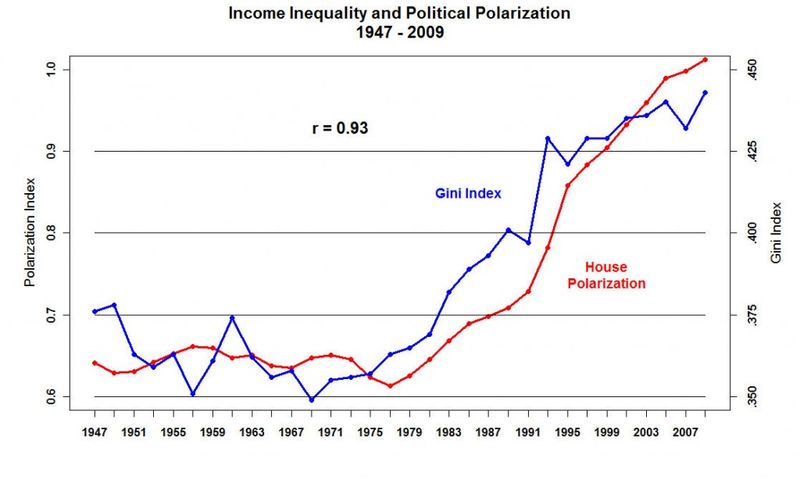
Inequality and polarization go hand in hand, leaving our country divided and unable to deal with important issues, like the deficit or the environment. The unfortunate Citizens United decision gave corporations the same freedom of political speech protection enjoyed by individuals, leading to unlimited corporate money in politics, pushing America further from democracy to plutocracy.

Hope?

Stiglitz offered a few thin rays of hope. Can America change course? Well, it has in the past. As in our own age, inequality was high in the gilded age of the late 1800's and again in the 1920's. Also notably, both eras were marked by financial crises. In each of these cases, America changed course to temper the worst of the excess.

In more recent times, Brazil has succeeded in swimming against the tide of rising inequality. Stiglitz credits the Brazilian elite for realizing that a more level playing field would lead to a more stable and functional society. Will their American counterparts realize that the collapse of the middle class is not in anyone's best interest?

More

Monday, June 11, 2012

Capital stock vs. GDP per person

From the Economist of May 26, Special report: China's economy, Investment: Prudence without a purpose; Misinvestment is a bigger problem than overinvestment.

That's a nice linear relationship shown in all the Asian countries. What explains the lower slope of the US - high GDP but lower growth in capital stock? Is the US underinvesting / overconsuming? Much of the growth over this time in America was the rise of the finance industry, which is not capital intensive, whereas the Asian countries are more weighted towards manufacturing.

I wonder what the breakdown is of each economy in terms of manufacturing vs. services.

Tuesday, March 20, 2012

Corporations United

The absurdity of the republican primary has set me to thinking about the catastrophic Citizens United decision by the Supreme Court. How anyone in their right mind could think that what this county needs is more corporate money in politics is totally beyond me.


(photo: seth_schneider)

In the dissenting opinion in the Supreme Court's Citizens United ruling, Justice John Paul Stevens wrote:

“A democracy cannot function effectively when its constituent members believe laws are being bought and sold.”

According to Senator Bernie Sanders (I-VT) , “Americans are profoundly disgusted by the Citizens United decision and what it means for our democracy.”

That's why Sanders is trying to build momentum for an amendment to overturn Citizens United. The Saving American Democracy Amendment states that:

  • Corporations are not persons with constitutional rights equal to real people.
  • Corporations are subject to regulation by the people.
  • Corporations may not make campaign contributions or any election expenditures.
  • Congress and states have the power to regulate campaign finances.

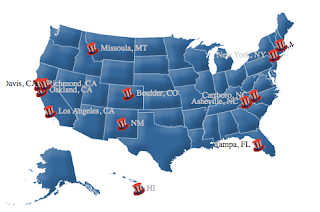
The New Mexico state legislature passed a measure calling on congress to overturn Citizens United. You can read about this almost nowhere in mainstream news. Several other states and local governments have introduced similar measures to similar lack of fanfare. Among them, Hawaii and California, and towns in Massachusetts and Vermont.

Organized opposition to Citizens United

  • Amend2012 a project of Common Cause
  • Free Speech For People (FSFP) is a national, non-partisan campaign seeking to restore democracy to the people and to ensure that people, not corporations, govern in America. FSFP is dedicated to overturning, through a 28th Amendment to the US Constitution, the US Supreme Court’s January 2010 ruling in Citizens United v. FEC and a corporate rights doctrine, which threatens our elections and our self-government.
  • Corporations Are Not People
  • Move To Amend End corporate rule. Legitimize democracy.

More News

Tuesday, March 13, 2012

The Rise of Private Power

David Rothkopf spoke yesterday at Seattle Town Hall on the rise of private power on a cold rainy night.

Rothkopf served as deputy under secretary of commerce for international trade policy in the Clinton Administration. Rothkopf was managing director of Kissinger Associates, an international consulting firm, founded and run by Henry Kissinger and Brent Scowcroft and went on to start two international advisory firms of his own. He is now a visiting scholar at the Carnegie Endowment as well as CEO and editor at large of Foreign Policy magazine.

Rothkopf is the author of three books, most recently, Power, Inc.: The Epic Rivalry Between Big Business and Government and the Reckoning that Lies Ahead.

Power, Inc.

Rothkopf begins with the origins of corporations in the Europe of the middle ages where church and state competed for power. Since that time, the world has moved to an era in which the axis of political tension is beween corporations and the state.

Governments midwived the birth of corporations, creating early state sponsored companies like the Dutch and British East India companies, an event soon followed by the South Sea Island Bubble. Church, state and the corporation are different approaches for controlling and allocating wealth, status and authority in society. In western countries, the church was largely tamed. But, in the modern day, laissez-faire capitalism has enabled the corporation to become a serious rival of state power.

There are several means of deploying power available to nations - control of borders, printing money, passing laws, military force. Multinational companies can circumvent many of these by changing domicile to the most favorable legal environment. Most financial instruments are created by private entities. Some big corporations have larger cash flow than most countries.

The financial crisis was a shocking demonstration of corporate power. When the shit hit the fan, who did we help? Homeowners? Nope, Wall Street. Next came the Citizens United decision, a milestone in the increasing political rights of corporations.

Thomas Jefferson, William Brandis and Adam Smith all mistrusted corporations and feared their influence on politics. Alexander Hamilton was their early cheerleader in American history and architect of the framework in which corporations helped America rise to power.

Adolf Fassbender, The White Night, 1932

American Capitalism

The financial crisis left the reputation of Anglo-American Capitalism in taters and the disfunction of American politics isn't helping America's influence in the world. Rothkopf took a big swipe at the premature triumphalism of the 1990's exemplified by Francis Fukuyama's The End of History which asserted that the Washington Consensus represented "the end point of mankind's ideological evolution and the universalization of Western liberal democracy as the final form of human government."

Ideologicalization of American politics has rendered constructive debate impossible. (Ideology sucks! See the tag-line above.) The great opportunity presented by the crisis for financial reform was wasted. The watered down reform that was enacted remains underfunded and mostly unimplemented.

As traditional forms of state power are increasingly ineffective, the US government has put all it's chips on military power, developing its comparative advantage at projecting force. This is the "leviathan" doctrine articulated in Thomas Barnett's 2004 book The Pentagon's New Map, which set out a grand strategy for an American foreign policy specializing in policing the globalized world economy.

Different capitalisms

What is taking the place of the Washington Consensus, both between and within countries, is a competition among several different varieties of capitalism: state capitalism, entrepreneurial capitalism, small business capitalism, chaotic capitalism.

Can corporations be made to serve societies? Rothkopf believes so. But, we need to intelligently discus the alternatives, and be willing to cede authority upward to transnational bodies. Viewed in this light, the EU as an experimental attempt to regain lost sovereignty. Rothkopf also cited public/private partnerships such as those that created the transport system in the US and the internet.

The Scandinavian countries, Rothkopf pointed out, are near the top of the rankings, including quality of life, education, and per-capita GDP. It's amusing to note that socialist Sweden let Saab go under at the same time the nominally capitalist US was bailing out GM. The reason? A generous safety net in Sweden made bankruptcy possible.

Rothkopf, perhaps understandably considering his background in publishing, sees a comparative advantage in protection of intellectual property. I see problems with that. At least in its current form, IP law overwhelmingly favors big companies, holding back innovation. Patents and copyrights are a blatant example of corporate manipulation of the legal environment. Erecting barriers to the creative remixing of ideas will merely succeed only in exporting the vibrant technology sector and with it another of the crown jewels of the American economy.

Rothkopf's intelligence and scholarship were evident throughout his thought-provoking talk. The same could not be said of the questioners in the Q&A session. The city that brought the world the Battle of Seattle couldn't muster many rhetorical molotov cocktails. Step it up, Seattle.

More

Sunday, December 18, 2011

Stop SOPA

In a matter of days, it looks likely that congress will pass SOPA (the Stop Online Piracy Act), another gift to special interest groups from motion picture and recording industry.

The bill targets sites like Sweden's The Pirate Bay, Hong Kong based MegaUpload or the Dutch site TorrentFreak requiring search engines, discussion forums, blogs and DNS providers to censor access to these types of sites prompting comparisons to China's great firewall.

The technical cluelessness on display in the congressional hearings is embarrassing, but, really, who expects anything different? Leading engineers have petitioned in opposition on the grounds that this legislation imposes serious burdens on infrastructure providers and probably won't even work.

How big a problem is this?

Technical issues aside, we should recognize that bootlegging movies or music is a fairly low-cost crime as far as society is concerned. Comparing it with illegal drugs, as The Economist does, is a joke when you think about lives wrecked by meth or crack or the ongoing drug war in Mexico. Piracy seems pretty benign next to the consequences of financial malfeasance in recent years, but now we're talking radical crazy talk.

The biggest consequence of piracy is that an artificial monopoly is less lucrative than it would otherwise be. Legal monopolies have a long history of abuse. They're a great way for politicians to give out favors and ask favors in return. In a textbook specimen of double-speak, any recognition of this economic and political reality is called sympathetic to piracy, something like being called a pinko in the McCarthy era.

A couple definitions

Rivalry is an economic concept describing whether the use of a good by one party precludes its use by another. The distinction being made here means that a million people could listen to Lady Gaga's latest tune at the same time. A million people could not ride in my car or live in my house. My house and car are rival goods. Songs are non-rival.

For every copyrighted work not pirated, how many would be purchased? My guess is that this ratio is low. I'm pretty sure nobody has convincingly shown otherwise. For the items not purchased, the utility of consuming them is lost, with no corresponding gain to the monopolist. This is called a dead weight loss, meaning some people could be made better off without making anyone else worse off, but we fail to do it. This loss is the music/movies/etc that wouldn't be enjoyed if they weren't pirated.

Willful ignorance of these simple but important ideas bugs me a lot more than bozo-grade technical knowledge.

Which is worse, the problem or the solution?

Now, it's important that creators of valuable intellectual property make a decent living. Few question that. What we're talking about is whether publishers should put up toll booths on the road between the consumer and the producer, and whether the government should enforce the use of these toll roads, when technology has made such choke points obsolete. Since distribution is now practically free, is it a good idea to create costly and ultimately ineffective legal barriers to replace the physical barrier that no longer exists?

Let's total up the costs. There's dead weight loss. There's a loss to innovation and culture which suffer when the interchange of ideas is impeded. There's the technical costs of implementing measures like SOPA, (and DRM and copy-protection before it), which tend to fall on paying customers.

To be fair, a partially market based means of valuing intellectual property and rewarding its creation is not to be dismissed lightly. Blocking access to download sites will result in some revenue trickling down to deserving artists. Too bad, no one speaks about the issue in terms of balancing benefits against costs.

The real problem

[The nightmarish SOPA hearings By Alexandra Petri, Washington Post]

It's shameful that congress is so eager to shill for corporations and their lobbyists rather than protect the interests of the people they are elected to serve.

Update:SOPA and it's sister PIPA (the PROTECT IP Act) have been temporarily shelved, thanks to an enormous public outcry and the opposition of Oregon Senator Ron Wyden. Clay Shirky sums it up, like so:

We should delight in the stand we’ve taken in favor of things like, say, notifications, and trials, and proof before censoring someone, but we should get ready to do it again next year, and the year after that. The risk now is not that SOPA will pass. The risk is that we’ll think we’ve won. We haven’t; they’ll be back. Get ready to have this fight again.

Monday, August 1, 2011

Making the patent system even worse

The economist explains the state of the US patent system like this:

At a time when our future affluence depends so heavily on innovation, we have drifted toward a patent regime that not only fails to fulfill its justifying function, to incentivise innovation, but actively impedes innovation. We rarely directly confront the effects of this immense waste of resources and brainpower and the attendant retardation of the pace of discovery, but it affect us all the same. It makes us all poorer and helps keep us stuck in the great stagnation.

Congress is in the process of passing a "first-to-file system". It's hard to see this as anything but a gift to big corporations. Writing in Foreign Policy, Clyde Prestowitz calls the Americans Invent act, "...a bill likely to cut the heart out of our innovative, entrepreneurial culture...". Even the pro-patent group American Innovators for patent reform says,

American Innovators for Patent Reform is opposed to the America Invents Act and we urge the House of Representatives to draft an entirely new law that truly addresses what needs to be reformed. The America Invents Act was crafted by lobbyists for the large corporations that are notorious infringers of patents!

...and...

Canada made the switch to first-to-file in 1989, and a 2009 study from researchers at Canada’s McGill University’s Department of Economics found that the change “failed to stimulate Canadian R&D efforts” and “skewed the ownership structure of patented inventions towards large corporations, away from independent inventors and small businesses.

It looks like the US patent system is about to become even more screwed up.

Nice work as usual, congress.

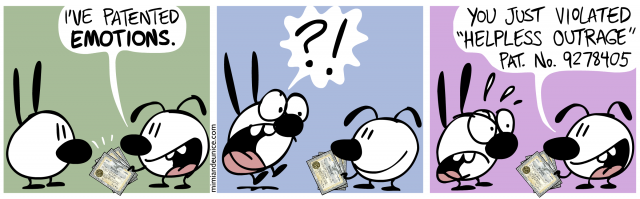
BTW, Mimi & Eunice is a work of genius

More links

Tuesday, June 28, 2011

The Deficit Is Worse Than We Think

In a WSJ op-ed, Lawrence Lindsey, a former Federal Reserve governor and assistant to President George W. Bush for economic policy, gives three reasons why The Deficit Is Worse Than We Think

  • Interest expense
  • Anemic growth
  • Health care costs
At present, the average cost of Treasury borrowing is 2.5%. The average over the last two decades was 5.7%. Should we ramp up to the higher number, annual interest expenses would be roughly $420 billion higher in 2014 and $700 billion higher in 2020. Normal interest rates would raise debt-service costs by $4.9 trillion over 10 years, dwarfing the savings from any currently contemplated budget deal. [...] The Fed will increasingly have to factor in the effects of any rate hike on the fiscal position of the Treasury.

Wednesday, September 1, 2010

Let the Bush tax cuts expire

Has the Wall Street Journal gone totally right wing nutballs or has it always been that way? A recent article on the expiration of the Bush tax cuts gives cause for concern.

In the summer of 2007, Rupert Murdoch prevailed upon the Bancroft family and sucked the WSJ into the media empire of News Corp. Murdoch's other properties include Fox News and the New York Post, neither of which are exactly monuments to journalistic integrity. As a very occasional reader, I can't say whether or how much the WSJ has changed since.

In the weekend edition of August 28, 2010 an unsigned editorial titled The $31 Billion Revenue Fantasy complains about the plan to let the Bush tax cuts expire. They make the claim that the Bush tax cuts were not a windfall for the rich. After the particularly piercing argument "Yada, yada, yada," (really, they said that), they throw up a bunch of numbers. It's not that surprising to find a sermon to the anti-tax faithful in the WSJ. But, the totally bogus and deceptive line of argument they use has a real Fox News ring to it. For example:

The IRS data show that in 2003 those with incomes above $200,000 paid $313 billion in income tax. By 2007 they paid $610 billion. When the recession hit, the payments fell to $537 billion in 2008. But even accounting for that decline, payments by the rich were still 65% higher five years after the rate cut that was supposedly a giveaway to the rich. The share of federal income taxes paid by the $200,000-a-year club was 42% in 2003 but 52% in 2008. (The IRS doesn't adjust these annual numbers for inflation.)

Inflation is only one reason why these numbers are not very meaningful. According to CPI numbers, 100 2003-dollars is about 117 2008 dollars. So, even if incomes only track inflation the pool of 200k-plus tax-payers grew. Also at the same time, the economy was expanding (and bubbles growing in housing and finance), which also lifts people into the higher income bracket. Tax receipts at all levels go up with the economy. Tax receipts from higher brackets go up more. Finally, high-income earners (for example those already over the 200k line) saw their incomes increase at a rate greater than the economy as a whole, thus paying more taxes.

These numbers are completely consistent with the story that the rich got richer while being taxed at a lower rate. As the New York Times put it:

Though tax cuts for the rich were bigger than those for other groups, the wealthiest families paid a bigger share of total taxes. That is because their incomes have climbed far more rapidly, and the gap between rich and poor has widened in the last several years.

- NYT “Tax Cuts Offer Most for Very Rich”

In 2003, 450 economists signed a statement (Economists’ statement opposing the Bush tax cuts (2003)) opposing the Bush tax cuts on the grounds that they would fail as a growth stimulus, increase inequality and worsen the budget outlook. Even Alan Greenspan thinks these tax cuts should expire as do former Treasury Secretaries Robert Rubin and Paul O'Neill.

The real question the editorial is trying to address is what degree of progressivity do we want in our tax system. Should those who have benefited most, in turn, support the system most? That's a fair and legitimate question. As economist Russ Roberts puts it, “Should we be more like France or less like France?”

What disappoints me about the WSJ article is this: Shouldn't the readers of the WSJ - educated businessmen, rather than tea-party loonies - be able to think this through soberly and logically? Given the audience of the WSJ, we're left with the scary conclusion that many of the wealthy are lying to themselves to justify their own sense of entitlement. Either that, or they're trying to arm themselves with deceitful and self-serving arguments to manipulate those less savvy than themselves.

There are common features to be found in several species of voodoo economics from the Laffer curve and trickle-down economics to "starving the beast" to the claim that letting the Bush tax cuts expire would stifle the recovery. Numerical quackery obscures policy that always seems to favor the rich at the expense of the common good.

What about what's good for the country? Shouldn't the country's business elites have a few ounces of patriotic blood in their veins? And might that lead to pursuit of goals that are good for America as a whole; strategies that grow the pie for everyone rather than tactics for capturing an ever bigger slice?

Related stuff

Thursday, July 8, 2010

Andy Grove: How America Can Create Jobs

Andy Grove: How America Can Create Jobs, July 1, 2010
In a thorough study of the industrial development of East Asia, Robert Wade of the London School of Economics found that these economies turned in precedent-shattering economic performances over the '70s and '80s in large part because of the effective involvement of the government in targeting the growth of manufacturing industries.
While pursuing our company goals, all of us in business have a responsibility to maintain the industrial base on which we depend and the society whose adaptability—and stability—we may have taken for granted.

Wednesday, March 17, 2010

Joseph Stiglitz

Notes on: Joseph Stiglitz: The Economics of Information, an interview at The Asia Society from February of 2008.

Balance of global power is shifting due to:

  • rise of china and india
  • financial crisis
  • US debt

International organizations designed around the post WWII power structure are out of date and failing due to lack of legitimacy. True of the World Bank, IMF, and G8. Advocates the rule of law between nations and points out that the invasion of Iraq was a violation of international law.

US foreign policy often made for the benefit of campaign donors. Intellectual property rights deals made in secret undemocratically that favor narrow interests in the US. Much of foreign aid is also part of a global military strategy rather than truly for purposes of aid.

Why is China, a non-democracy, growing faster than India, a democracy? Stiglitz claimed that China allows more participation. (really?) China is investing heavily in Africa.

Under what conditions does Adam Smith's invisible hand work? In other words, are markets efficient always or under specific conditions? The financial crisis seems to be a case where the market failed. Market handle some situations poorly: imperfect information, externalities, public goods.

Median income in US lower today (2008) than 7 years ago and among males, lower than 30 years ago. Globalization is only one factor, but an easy target because the blame falls on outsiders. Social protection is not protectionist.

The stimulus package gives little directly to the unemployed, where it would be most effictive, due to being immediately spent. Stimulus should be spent on assets that will increase our future income.

GDP flawed measure. Median income can fall while GDP is rising if inequality is also rising. GDP neglects degradation of the environmental and depletion of resources. Switch from GNP to GDP politically motivated? (example: resource extraction).

Links

A political economy

A recent piece in the Economist ( A new anthology of essays reconsiders Thomas Piketty’s “Capital” , May 20, 2107) ends with these words: ...