Showing posts with label book. Show all posts

Friday, September 4, 2015

A Very Short Introduction to Economics

Partha Dasgupta's A Very Short Introduction to Economics packs a lot into a few pages. Though incomplete and selective, it does a great job of guiding the reader through the intersections of economics and history, development, sociology and ecology.

The book is framed by contrasting the lives and prospects of two children, one in the suburban US, the other in rural Ethiopia, analyzing the factors of economic development that make the difference between communal subsistence agriculture and highly-specialized developed markets. Touching on a bit of game theory, Dasgupta shows how trust arises from mutual benefit and breaks down in the presence of uncertainty. Communities help to stabilize and safeguard trust, but in developed economies institutions increasingly ensure trust between parties who never meet.

Institutions like markets, courts and governments come easily to mind, but science and technology are two institutions of primary importance to economic development, a fact that Dasgupta crystallizes: "What Europe achieved during the Age of Enlightenment was [...] It created institutions that enabled the production, dissemination, and use of knowledge – in effect, the entire knowledge industry – to be transferred from small elites to the public at large, a transfer that so sharpened the analytic-empirical mode of reasoning that it became routine." (p99)

Science and technology are examined as institutions and economic inputs. The book sketches the unusual landscape of incentives that animate science in which highly speculative bets placed by research funders reward the successful scientist in terms of primacy and honors rather than cash and pay off for society in terms of knowledge as a public good. Dasgupta captures the tense relationship between science and technology like so:

"Increasingly though, the taste for those social contrivances has to compete against the pecuniary rewards available in Technology. If the pecuniary rewards increase – and they have increased greatly in recent years – the taste for the mores in Science becomes more and more of a luxury to the research worker. Science embodies a set of cultural values in need of constant protection from the threat posed by its rival, Technology. That threat has proved to be so real, that in recent decades the two institutions have begun to blur into each other. Scientists increasingly behave like technologists, while technologists enjoy both the pecuniary rewards of Technology and the medals and scrolls that Science has to offer." (p98)

Patents are covered but without mention of their central conflict, which the Economist expressed recently this way: "Patents are protected by governments because they are held to promote innovation. But there is plenty of evidence that they do not."

Sustainability is one of the most intractable issues of our time. Natural resources serve as economic inputs. Moreover, ecosystems provide economic services whose value escapes conventional economic analysis. Going further still, one may consider the entire human economy as a subsidiary of the earth's ecosystem. It'll strike some as a bit on the fringe to think of economics as a subsystem of nature or dwell on their deep similarities in terms of competition, adaptation, and exchanges of material and energy, but there's a very rich intellectual history behind these ideas.

Robert Frank calls Charles Darwin the father of economics as well as evolution. Turning that the other direction, economic concepts such as pareto optimality can inform the study of evolution. The central role of competition is explored in Geerat Vermeij's book, Nature: An Economic History. Organisms or organizations compete for resources, especially energy - the energy to go capture more resources. Looking at energy as the primary economic input goes at least as far back as 1921 to an address given by Frederick Soddy called Cartesian Economics. In terms of thermodynamics, it's the flow of free energy from the sun that drives local increases in order on our little planet. This is true in living systems as well as economic ones. On this topic, I'm looking forward to diving into Why Information Grows By Cesar Hidalgo. On the other hand, Mark Sagoff's essay, The Rise and Fall of Ecological Economics is critical of this line of thinking.

Those expecting A Very Short Introduction to Economics to follow a traditional economics curriculum will be disappointed. Many key economic concepts - opportunity cost, comparative advantage, elasticity are mentioned in passing or merely alluded to without naming them. Even supply and demand curves are relegated to a middle chapter. If you don't like the social-science side of economics, this is not the book for you. Also, the book is not mathy, which should be apparent from the concept of the VSI series.

One of my personal favorite ideas only gets a paragraph (p78) - Hayek's beautiful insight into the role of markets and price signals as parsimonious integrators of distributed information. Distributed computing teaches us is that coordination - transferring information, reaching agreement - is hard and expensive. The nifty trick of markets is that they tend towards efficient resource allocations while keeping down the cost of coordination. Of course, technology is good at spreading information around:

Despite the selectivity, it might be inevitable that I would like this little book since it connects several of my obsessive interests - economics, science and specifically life science. Both economics and biology are, at heart, the study of complex adaptive systems. Or in Venkatesh Rao's view, they are "soft technologies". Rao says, "Software has the same relationship to any specific sort of computing hardware as money does to coins or credit cards or writing to clay tablets and paper books." Likewise, I'd add, DNA codes living systems that run on the substrate of the cell.

Dasgupta clearly gets the perspective of the economy as a complex system made up of densely interconnected parts - households, firms and institutions - deeply linked to social and political systems and embedded in the natural world. With this encompassing breadth, the reader is well prepared to pick up a more traditional economics text with the big picture firmly in mind.

Tuesday, July 2, 2013

Restless Empire: China and the World since 1750

At some point during this century, China will become the world's largest economy, while the US will still be the largest military power in a multipolar world. These transitions are historically dangerous.

The relations of China with the rest of the world will be a critical part of this swing in the balance of power. China, through the lens of its foreign relations, is the topic of “Restless Empire: China and the World since 1750” by O. Arne Westad, a Professor of International History at the London School of Economics specializing in the Cold War and contemporary East Asia.

The past couple centuries have traumatized China - humiliating concessions to the European powers, civil war, terrifying abuse at the hands of the Japanese, and the self-inflicted disaster of the cultural revolution. These events shape Chinese world-views today. The book is about China's search for a workable hybrid between modernity and Confucian tradition, between eastern and western political and social thought, among its diverse interior regions and between China and the outside world.

What I take to be the main messages of the book are these:

  • China has always been an empire and still is.
  • The traumatic events of the past couple centuries are the drivers of modern Chinese relations with the outside world.
  • Ongoing change in China is fast, sweeping and the outcomes are unpredictable but sure to have a huge impact on the world.

The cycle of empires

There is a sense of centrality deeply ingrained in Chinese thought. For centuries, the place of the middle kingdom was at the center of a tributary system encompassing most of east Asia.

A regular cycle seems to have repeated over millenia in which a dynasty holds the center of power for a as little as a few decades or as much as a few hundred years. Over time, regimes weaken through corruption or infighting and fall followed by messy and prolonged periods of chaos from which a new rulling class would eventually emerge.

At the height of the Qing Dynastry, China's economy was growing with trade links to Southeast Asia, Japan and Europe, and a merchant class was rising along with it.

The Treaty of Nerchinsk (1689) established the boundary with Russia and is the oldest treaty in which China dealt with a foreign power on a equal basis. But, the Qing adopted the tributary model when faced in the 1700's with the first emissaries from the expanding trade empires of the Portuguese, Dutch and British. This was a critical mistake.

The Qing were slow to realize the threat posed by the industrialized economies backing the foreigners. Preoccupied with the rules and rituals of court, convinced of their cultural superiority and the centrality of the middle kingdom, the Qing failed to see any need for change.

There followed a series of increasingly disastrous confrontations with European powers. While colonial powers enforced treaty ports and extraterritoriality by gun-boat diplomacy, China was further debilitated by internal uprisings, bloody successions, and loss of territory to Russia and Japan.

The opium wars of 1840 and 1860 ended with the destruction of the summer palace in Beijing by the British. Unable to repel the foreigners, the declining Qing could only appeal to tradition to prop up their sagging legitimacy.

The failure of the Boxer Rebellion (1898-1901) under the slogan “Support for the Qing and extermination of foreigners” left the dynasty in an untenable position. Partition of China into colonial possessions was only narrowly avoided.

Modernization delayed

Japan's emergence as a modern industrialized nation during the Meiji Restoration (1868-1912) served as a model for many Chinese reformers including Sun Yat-sen. This inspiration was not well received in the centers of power, perhaps due to the Japanese view of the Qing with their Manchurian ancestry as barbarian conquerers, a view that may have had sympathy within China itself. Further complicating matters, the Sino-Japanese War of 1894-1895 extended Japanese influence over Korea, formerly a Chinese tributary.

The Republic period began with great hope for modernization. In 1911 the Republic of China was declared with Sun Yat-sen as provisional president. If events had not taken several turns for the worse, China might have begun its modernization at this point, rather than the 1980's. But, the republic never stabilized, degenerating instead into the Chinese civil war between Kuomintang forces led by Chiang Kai-shek and those of the Communist Party.

The political climate of Japan became increasingly militaristic, nationalistic and aggressive. Japanese inspired reformers were betrayed by Japan's brutal pursuit of imperial ambitions.

The civil war continued right on through the Japanese occupation, seeding conditions for an ineffective response to the invasion and discrediting the republican government. As WWII dragged to a close, any semblance of a united front broke down and fighting soon resumed. In 1950, the communists finally defeated the KMT forcing a retreat to Taiwan.

Communism

In China and other colonial enterprises, the banner of Capitalism was used as a cloak to wrap around exploitation. Instead of free and open markets, exclusive rights were granted to colonizers with gunboats. The local elite was allowed to retain a measure of privilege conditional on cooperation, while the lot of the common native was to be cheap expendable labor.

An ideology that presented itself as an alternative to this one-sided arrangement, unsurprisingly, looked pretty good. In contrast to Mao's unhinged obsession with finer points of doctrine, the appeal of communism to the average Chinese has to be simply as a means of opposition to exploitation and occupation by foreigners.

The post-colonial era played out in similar ways in Burma, Korea, Vietnam, Laos and Cambodia - the rise of communism accompanied by civil war and pathological spasms of violence like the cultural revolution and the purges in Cambodia.

The transition from Marxism to whatever China is today - market socialism, state capitalism, socialism with Chinese characteristics, obfuscated by the need to fundamentally change policy with minimal admission of error, forces party theoreticians into awkward and convoluted rationalizations. Even so, Chinese adoption of market methods has been an amazing success. For most Chinese, central planning and collective ownership were never as important as an end to independence and prosperity.

USSR / Russia

Relations between China and Russia have been at least as bipolar as those with America.

Soviet troops fought the Chinese to maintain control of the Manchurian Chinese Eastern Railway in 1929. The Russians had designs on Xinjiang as far back as Czarist times with troops stationed in the region between 1934 and 1942.

In the 1950's, Russia was the center of world communism. Mao, unhappy in a secondary role, incited nonsensical ideological battles with the Soviets and grew to mistrust the intentions of Russian involvement in Vietnam, though still fighting together against the common enemy as they had in Korea.

That the Chinese leadership of that time let such an obvious alliance go so far wrong raises questions about their grasp of the situation and level of paranoia. The countries nearly came to war in 1969 over control of a handful of islands in the Amur and Ussuri rivers.

In recent times, China has pivoted politically back towards improved relations with Moscow, even while trade with the U.S. has boomed. The transition to markets was handled very differently in the two countries. The controlled pace of change in China is in deliberate contrast to shock therapy. After following very different trajectories in the post-cold war era, the two countries have converged on models that are in some ways similar, with a strong central state, and in some ways complimentary, becoming an exporter of commodities on the one hand and of manufactured goods on the other.

The Russian far east is vast, empty, and rich in resources but economically stagnant, while China is crowded, resource hungry, and booming. It's logical then that the region is seeing a rapid influx of Chinese. The Shanghai Cooperation Organization forms the basis for China to become a huge market for Russian energy and military exports.

America

Complicated can be the only word for the relationship between America and China. For China, America is equally a model and a rival. Both countries share a belief in their own exceptionalism. The countries have been alternately partners and enemies over the 20th century.

The US holds a noticeable chunk of the Chinese diaspora. The 2010 census counted 3.8 million Chinese Americans. This is in spite of the Chinese Exclusion Act of 1882 which banned immigration from China, due to a perceived threat of cheap Chinese workers. The act remained in effect until 1943.

As a former colony, America could plausibly claim to sympathize with China's mistreatment at the hands of colonial powers. Rather than see China carved up, President William McKinley supported an independent China. Post-colonial brotherhood aside, maintaining American trade access was an important consideration. In 1900, McKinley sent 5,000 American troops to help quell the boxer rebellion, an expansion of presidential powers that would later be echoed in the Korean and Vietnam wars.

During the republic period, the United States strongly supported the Kuomintang forces, in continuity with its present day support of Taiwan.

U.S. and Chinese troops fought in Korea and China supplied equipment and transportation engineering during the Vietnam war.

As the U.S. presence in Vietnam ramped up, China was still recovering from the disastrous great leap forward and wanted to avoid another direct confrontation with the U.S. but also wanted to be seen as the vanguard of worldwide communist revolution. The extent of Chinese involvement in Vietnam has been a source of debate. But, it's clear that China committed significant resources at a time when their own economy was in tatters, their relationship with the U.S.S.R was falling apart, and even the Vietnamese were coming to mistrust them.

According to China's Involvement in the Vietnam War (Chen Jian 1995):

From early August 1965 to March 1969, a total of 16 divisions (63 regiments) of Chinese anti-aircraft artillery units, with a total strength of over 150,000, engaged in operations in Vietnam. ... The Chinese statistics claimed that these troops had fought a total of 2,154 battles, and were responsible for shooting down 1,707 American planes and damaging another 1,608.

After the Sino-Soviet split, Nixon and Kissenger initiated rapprochement with China in the early 1970's as a cold war tactic against the USSR. With the ascendance of Deng in 1979, China began adopting market economics and export-led growth.

From almost nothing, trade between China and America grew to the level where the U.S. exports 110 billion in goods to China while importing 425 billion (2012 numbers from the U.S. Census Bureau). The arrangement by which America provides a huge market for China's exports and China soaks up American debt was named Chimerica by Niall Ferguson and Moritz Schularick.

Henry Kissenger, wrote in 2011 in the WSJ,, "China and the U.S. could easily fall into an escalating tension," and told a reporter:

"Is it possible to achieve enough of a cooperative pattern to avoid sliding through a series of mutual misconceptions, of stepping on each other's toes, into a situation where an ultimate confrontation becomes inevitable? And looking at the fact that we have not known how to end our little wars, I have no great hope that either side would know how to end such a conflict. ...Am I optimistic that it's going to be done? No."

Structure

Thinking about China as a unit can be deceptive. Its structure is decentralized, with the center weilding powerful but supervisory authority. China is broken up into 23 provinces and 5 autonomous regions, which are further subdivided into prefectures, counties, districts and villages. The largest 4 cities are municipalities. Hong Kong and Macau are special administrative regions. In addition, there are several special economic zones and the truly special case of Taiwan.

The country is divided along several axes: regional, ethnic, religious, rural/urban, coastal/interior. China is rapidly urbanizing, but has a substantial population in the countryside. Corporate power centers have developed since privatization.

In some ways, China is divided from it's own history:

"To quite some extent, young Chinese today are cut off from much of their past. They are cut off linguistically, because they do not know the classical Chinese and, therefore, they are not able to read, in effect, anything that was written prior to the 1910s."

Riding herd over this sea of divisions, the central government has something in common with transnational bodies like the EU or neighboring ASEAN.

Future

With this in mind, China is in many ways still is the empire it has always been, encompassing a vast and varied geography, many distinct races and cultures, and ruled by a comparitively tiny elite in Beijing. Westad argues that its political structure is unlikely to remain as it is.

China may slowly follow a path similar to Korea, Singapore, Japan and Taiwan, with government led economic growth followed by an increasingly participatory political system. Or China's hyperspeed industrial revolution may stall out with aging demography into a middle income trap.

Just as cold-war era Eastern Europeans could see the better material conditions in the west, mainland Chinese are increasingly aware of the prosperity in Taiwan, Korea, Hong Kong, creating intense pressure on the regime to deliver equally a high standards of living.

China does not want to destroy the US-led global economic system under which it has done so well and has no desire to end up like the Soviet Union. This makes cold war between US and China less likely. The Chinese doctrine of non-interference is a defensive posture focused on securing China's gains of the last 50 years and sustaining the flow resources necessary for economic growth.

Speaking on his book, Westad says, "What China wants at the moment is not to change the international system. It simply wants more for China within that system."

"China's focus is on its role as a regional power." China's foreign policy is immature, shaped by China's troubled recent history, alternating between a lingering sense of victimization and a temperamental nationalism. "The Chinese belief, held by every Chinese that I know, that China has been treated very unjustly over the past century, that China has been victimized."

Risk is concentrated in several potential flash points:

  • North Korea, Taiwan, the South China Sea
  • Xinjiang and Tibet
  • Border conflicts with India
  • problematic allies like North Korea and Pakistan

China is not in a "revolutionary situation", as long as the economy continues to work well. But, "Those who think that China will remain the way it is today for a very long period of time are certainly almost entirely wrong."

More

Saturday, June 16, 2012

The Price of Inequality

Nobel prize winning economist Joseph Stiglitz came to Seattle Town Hall this week to talk about a new book, The Price of Inequality. Here's the way I heard it.

US inequality

The US is the most unequal of all industrial nations as measured by Gini index. As much as Americans take pride in the equality of opportunity and social mobility offered by our country, that seems to be a thing of the past. While inequality is rising in wealthy countries around the world, it's rising faster here.

To quote the OECD: “The wealthiest Americans have collected the bulk of the past three decades’ income gains. The share of national income of the richest 1% more than doubled between 1980 and 2008: from 8% to 18%. The rising incomes of executives and finance professionals account for much of the rising share of top income recipients. Moreover, people who achieve such a high income status tend to stay there: only 25% drop out of the richest 1% in the US, compared to some 40% in Australia and Norway, for instance.”

Rent seeking

The greater wealth accumulating at the top is not due to greater contributions to society. Rent seeking, in the forms of outrageous executive salaries and bonuses, regulatory privilege, corporate welfare and transfers from the bottom to the top, explains much of the wealth of the top few percent. That's not to mention the 15% tax rate paid by the likes of Mitt Romney. As Warren Buffet says, “It's class warfare, and my class is winning.”

Rent seeking distorts the economy away from productive activity. Because the payoff is so high, the best and brightest rush eagerly from graduate school to the high-stakes increasingly zero sum sleazy gambling house that is the finance industry, forgoing useful arts like medicine or research.

Political disfunction

Some have propagated the idea that greater inequality leads to a more efficient economy and therefore greater wealth in total. But, how to explain the fact that several countries have less inequality and higher GDP and also higher quality of life. Looking at the lack of growth in median household income over the past thirty years, one must conclude that little is trickling down.

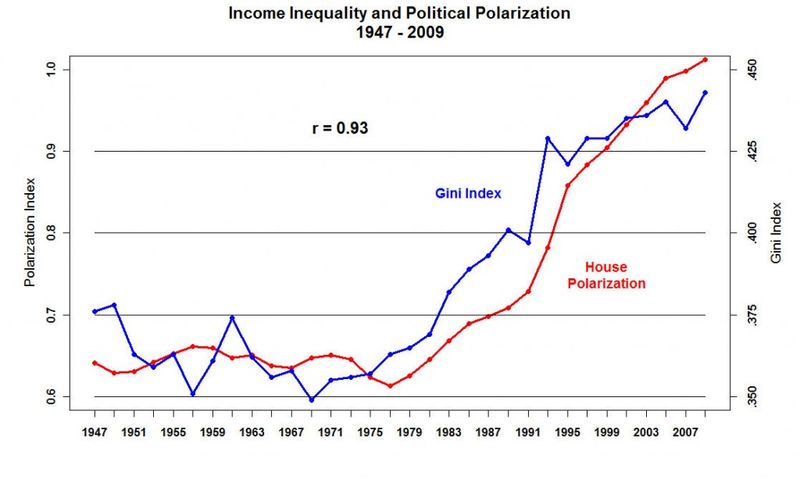
Inequality and polarization go hand in hand, leaving our country divided and unable to deal with important issues, like the deficit or the environment. The unfortunate Citizens United decision gave corporations the same freedom of political speech protection enjoyed by individuals, leading to unlimited corporate money in politics, pushing America further from democracy to plutocracy.

Hope?

Stiglitz offered a few thin rays of hope. Can America change course? Well, it has in the past. As in our own age, inequality was high in the gilded age of the late 1800's and again in the 1920's. Also notably, both eras were marked by financial crises. In each of these cases, America changed course to temper the worst of the excess.

In more recent times, Brazil has succeeded in swimming against the tide of rising inequality. Stiglitz credits the Brazilian elite for realizing that a more level playing field would lead to a more stable and functional society. Will their American counterparts realize that the collapse of the middle class is not in anyone's best interest?

More

Tuesday, March 13, 2012

The Rise of Private Power

David Rothkopf spoke yesterday at Seattle Town Hall on the rise of private power on a cold rainy night.

Rothkopf served as deputy under secretary of commerce for international trade policy in the Clinton Administration. Rothkopf was managing director of Kissinger Associates, an international consulting firm, founded and run by Henry Kissinger and Brent Scowcroft and went on to start two international advisory firms of his own. He is now a visiting scholar at the Carnegie Endowment as well as CEO and editor at large of Foreign Policy magazine.

Rothkopf is the author of three books, most recently, Power, Inc.: The Epic Rivalry Between Big Business and Government and the Reckoning that Lies Ahead.

Power, Inc.

Rothkopf begins with the origins of corporations in the Europe of the middle ages where church and state competed for power. Since that time, the world has moved to an era in which the axis of political tension is beween corporations and the state.

Governments midwived the birth of corporations, creating early state sponsored companies like the Dutch and British East India companies, an event soon followed by the South Sea Island Bubble. Church, state and the corporation are different approaches for controlling and allocating wealth, status and authority in society. In western countries, the church was largely tamed. But, in the modern day, laissez-faire capitalism has enabled the corporation to become a serious rival of state power.

There are several means of deploying power available to nations - control of borders, printing money, passing laws, military force. Multinational companies can circumvent many of these by changing domicile to the most favorable legal environment. Most financial instruments are created by private entities. Some big corporations have larger cash flow than most countries.

The financial crisis was a shocking demonstration of corporate power. When the shit hit the fan, who did we help? Homeowners? Nope, Wall Street. Next came the Citizens United decision, a milestone in the increasing political rights of corporations.

Thomas Jefferson, William Brandis and Adam Smith all mistrusted corporations and feared their influence on politics. Alexander Hamilton was their early cheerleader in American history and architect of the framework in which corporations helped America rise to power.

Adolf Fassbender, The White Night, 1932

American Capitalism

The financial crisis left the reputation of Anglo-American Capitalism in taters and the disfunction of American politics isn't helping America's influence in the world. Rothkopf took a big swipe at the premature triumphalism of the 1990's exemplified by Francis Fukuyama's The End of History which asserted that the Washington Consensus represented "the end point of mankind's ideological evolution and the universalization of Western liberal democracy as the final form of human government."

Ideologicalization of American politics has rendered constructive debate impossible. (Ideology sucks! See the tag-line above.) The great opportunity presented by the crisis for financial reform was wasted. The watered down reform that was enacted remains underfunded and mostly unimplemented.

As traditional forms of state power are increasingly ineffective, the US government has put all it's chips on military power, developing its comparative advantage at projecting force. This is the "leviathan" doctrine articulated in Thomas Barnett's 2004 book The Pentagon's New Map, which set out a grand strategy for an American foreign policy specializing in policing the globalized world economy.

Different capitalisms

What is taking the place of the Washington Consensus, both between and within countries, is a competition among several different varieties of capitalism: state capitalism, entrepreneurial capitalism, small business capitalism, chaotic capitalism.

Can corporations be made to serve societies? Rothkopf believes so. But, we need to intelligently discus the alternatives, and be willing to cede authority upward to transnational bodies. Viewed in this light, the EU as an experimental attempt to regain lost sovereignty. Rothkopf also cited public/private partnerships such as those that created the transport system in the US and the internet.

The Scandinavian countries, Rothkopf pointed out, are near the top of the rankings, including quality of life, education, and per-capita GDP. It's amusing to note that socialist Sweden let Saab go under at the same time the nominally capitalist US was bailing out GM. The reason? A generous safety net in Sweden made bankruptcy possible.

Rothkopf, perhaps understandably considering his background in publishing, sees a comparative advantage in protection of intellectual property. I see problems with that. At least in its current form, IP law overwhelmingly favors big companies, holding back innovation. Patents and copyrights are a blatant example of corporate manipulation of the legal environment. Erecting barriers to the creative remixing of ideas will merely succeed only in exporting the vibrant technology sector and with it another of the crown jewels of the American economy.

Rothkopf's intelligence and scholarship were evident throughout his thought-provoking talk. The same could not be said of the questioners in the Q&A session. The city that brought the world the Battle of Seattle couldn't muster many rhetorical molotov cocktails. Step it up, Seattle.

More

Tuesday, May 4, 2010

Book review: The Tipping Point

Malcolm Gladwell's book The Tipping Point (2000) is mostly about viral marketing and social networks. I'm surprised I read a book about such things, but it wasn't bad. It's written to be easy and popular rather than rigorous, so if you're familiar at all with the theory of networks, then there might not be a lot of truly new information here. The charming anecdotes that illustrate the ideas are the reason for its popularity.

I found myself recalling, with dread, my high-school years; navigating various social cliques, trying to emulate the cool kids, then shortly there-after consciously trying to be as opposite as I could. There's a lot of ugly stuff wired into our instincts as a tribal animal. But, like it or not, that's how we are.

MG identifies three special types of nodes in these social networks. Most obviously, there are connectors, people who seem to know everybody. They are the classic highly connected nodes. Messages propagate quickly through social networks with the help of connectors. Mavens are experts in some area who act as information brokers. Salesmen are charismatic persuaders. Due to the special properties of these personality types, MG derives the "Law of the Few", which boils down to this: Get connecters, mavens and salesmen on your side and the sheep will follow. Well, OK, he doesn't come right out and say, "Sheep".

  • connectors, highly connected people
  • mavens, people who are especially rich in information and who act as facilitators
  • salesmen, persuaders

Many of the folks we know and love in technology fit these personality types. The maven appeals most to me because they have a genuine interest in being helpful and in subverting the hype and finding the real deal. Most of us engineers are a little more cynical about the salesmen.

Messages themselves have properties that help them spread. Stickiness might come from the message itself or its packaging. Our psychology is such that we're much more receptive to ideas delivered in the right context, as exemplified by the broken-windows theory of law enforcement.

Most of MG's examples are from fashion and marketing. Two are about trendy shoes. DeeDee Gordon, a marketer that helped the Airwalk brand gain popularity in the 1990's sounds like the role model for William Gibson's cool-hunter Cayce Pollard from the novel Pattern Recognition. Now that I mention it, that's another book I might not have read if I knew how much it had to do with marketing, but a good one.

Just for the record, I rode a skateboard and never owned a pair of Airwalks, though I don't imagine I'm immune to manipulation. And it is manipulation because it's seeking to influence you for someone else's gain, rather than your own. That's the parasitic aspect of marketing.

MG tries to transcend marketing. He brings in suicide, smoking cessation, and cancer awareness. But, he keeps circling back. Even the one political theme he talks about, freeing tibet, worthy cause though it is, is sufficiently distant to be safe. It would be too bad if the main result of these ideas was more effective ways to sell trendy consumer crap to lemming-like mainstream losers. But, I don't mean to sound harsh. It's a good book. I just don't like marketing.

How about tapping our social networks and tribal instincts to spread messages about individual liberty, being a good person, working for justice, living beyond consumer junk-culture, or making the world a better place? Too bad, MG avoids any really revolutionary tipping points.

Tuesday, March 16, 2010

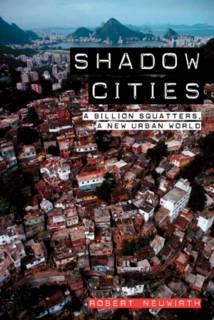
Book Review: Shadow Cities, A Billion Squatters, a New Urban World

Here's a review of Robert Neuwirth's book Shadow Cities, A Billion Squatters, a New Urban World that I wrote a long time ago, but left to rot on my hard drive.

Imagine a third world shanty town and likely what you’ll think of is rampant crime and dire poverty; a place most of us would fear to tread. Robert Neuwirth, a reporter from New York City, spent two years living in four different squatter settlements. From the favellas of Rio de Janeiro to the corrugated metal shacks of Nairobi, continuing to Istanbul and Mumbai. His book examines the truth on the ground of shanty towns and the history of squatter communities.

In the shanties, Mr. Neuwirth does indeed find desperation and heavily armed drug gangs straight out of the film City of God. But, he also finds decent people struggling just to get by, facing complex economic and political obstacles with creativity and vitality.

Mr. Neuwirth meets hard-working people who have admirably provided for themselves rather than wait for government, society, or the official economy to provide for them. This, in fact, is the central theme of the book. For their independence and initiative, they are rewarded with perpetual risk of persecution and eviction.

The legal authorities are frequently no friend to the squatter, or the poor in general. In the town of Cuzco, Peru, unless things have changed since I was there, there is a statue outside the courthouse; a big black mountain lion, claws extended, fangs bared in an expression of menace. This is the image the Peruvian justice system presents to its people. In fact, the squatters of Neuwirth’s book fall frequently prey to the whims of government officials or real estate developers.

Favela Rocinha, Rio

The legal limbo in which squatter communities exist is perilous, but not without advantages. The illegality of the squatter’s property serves to some extent as protection from confiscation by the authorities whether for taxation, dept repayment, or plain corruption. And many squatter communities happily pirate electricity and other utilities with relative impunity while they bootstrap themselves into modernity. Cottage industries thrive in the tax and regulation free environment of the unofficial settlements.

Being a software developer myself, the parallels between the squatters rebellion against legal barriers and the debate around intellectual property practically leapt out at me. We are in a period of enclosure of intellectual property similar to the fencing in of the great open spaces. Moneyed interests with allies in the legal system seek exclusive ownership rights. It might not be stretching the analogy too far to think of a shanty town as an open source city.

The economics of the unofficial economy and the interaction of wealth, power, and property rights are interesting and complex. Neuwirth’s book makes something of a hands-on companion to the theories of economist Hernando de Soto. Anyone with an interest in these subjects or a curiosity about the way of life in another world will enjoy Mr. Neuwirth’s book.

The vibrancy and ingenuity that Mr. Neuwirth finds in the slums contrasts vividly with the sanitized homogeneity of suburban consumer culture. It takes only a bit of imagination on the part of the reader to summon the sights and smells of the shanties; to visualize the gulf that divides their world from ours and the humanity that unites us.

Links

Monday, March 1, 2010

Great Powers: America and the World After Bush

The Carnegie Council hosts a great lecture series available as podcasts and videos. Military strategist Thomas P. M. Barnett (wikipedia) spoke on February 4, 2009 on his book, Great Powers: America and the World After Bush (audio, transcript).

Barnett's systems diagnostic view of the world

Barnett's basic argument is that globalization is a deliberate strategy on the part of the US to establish a world order in which developing nations can pursue export driven growth. America provides security, stability and a principle market, with the implicit agreement that trade surpluses would flow back into American debt instruments.

This american branded globalization consists of an international liberal trade order, collective security, high transaction network rates; most importantly, a competitive religious landscape. Stability operations are conducted to help establish order that advances U.S. interests and values. Great power war between the European powers or China-Japan-Korea-India has become unlikely. And there is a prevailing "minimal rule-set for connectivity to the global economy" that has moved about 3 billion out of poverty.

Historically, the American revolutionary war was, itself, a separatist guerilla action against the previous order. He credit's Alexander Hamilton's 1791 report on manufacturers as the first grand strategic document of the US. The early America was ruled by a succession of generals and revolutionaries and behaved in its early days much as Russia does now, with the exception that post-revolutionary America exported cotton rather than hydrocarbons. Slavery and ethnic cleansing are a part of America's history. Perhaps the industrialization of America during the robber baron days compares to China now.

Globalization was pursued as a continuation of the economic integration of the American wild west in the post-Civil War era. After the Civil War, through Theodore Roosevelt's time, regional economies were rapidly knit together into a continental economy. As the frontier was closed, economic integration with the outside world was the alternative to stagnation. (See Professor Frederick Jackson Turner's Frontier Thesis of 1893.)

Woodrow Wilson tries to establish an American order after WWI, but without sufficient military might is rebuffed by European powers. Finally, US kills colonialism at the end of WW2 (by Article 7 lend-lease agreement). Bretton Woods 1 established the World Bank, the IMF and the dollar as reserve currency and stabalized Europe during the cold war. Bretton Woods 2, after the demise of the gold standard in 1971 up until recently, underwrote the rise of Asia.

In this view, the US military has two roles - the Leviathan function, meaning the ability to fight big wars, and the system administrator function which maintains sufficient order for the functioning of the global economic network. During the cold war, the forces become overweighted in the Leviathan function to the extent that the integration skills honed on the American frontier deteriorated with visible consequences in Vietnam and Iraq. But, Iraq and Afghanistan are realigning and retraining a new generation of sys-admins.

America should be dedicated to encouraging democracy everywhere but we should be committed to forcing it nowhere.

We are in an age of integrating frontier markets. The major challenge over the next 20 years will be for the West and East to integrate the global south. The great divergence started by the industrial revolution then becomes the great convergence. A global middle class emerges. The high-trust environment of the West is now highly linked to the low-trust developing East. For access to raw materials, the low-trust East is integrating the no-trust countries of the bottom billion.

Economic integration comes before democracy and is better done by voluntary association than coercion. Wealth is the incentive to join the system. Democracy comes when countries are demographically middle class and middle aged. Markets bring this about by increasing income, creating a middle class and lowering birth rates.

To address this, the US military will realign toward system administration as the big war scenarios fade away. Taiwan will integrate Hong-Kong-style with China. Iran will become nuclear. America's tradition allies are demographically moribund, have declining defense budgets, and are increasingly unwilling to act geopolitically, while our new friends, the BRIC nations plus the Next 11 emerging economies, share the general goals of stability and economic interation.

Norman Angell, British philosopher, wrote the book The Great Illusion in 1911. It says: If the empires of the world in Europe went to war, they'd destroy each other and none of them would survive the process; so they're not going to do it because they're not that dumb. Turns out they were that dumb. Turns out they destroyed themselves. None of them are first-tier powers anymore as a result of that process. He gets the Nobel Peace Prize in 1933, sort of the consolation. [...People] say, "You're the second coming of Norman Angell." I say, "Damn straight, but I'm Norman Angell with nukes, and nukes change everything." They really do. And that's the good news.

Questions

Barnett played a role early in the GW Bush administration and supported the Iraq war. And I'm always suspicious when claims are made of a grand strategy after the fact. America is the result of globalization, not its cause. Globalization is the continuation of a process that goes back as far as civilization. This is a fascinating talk, regardless of how much you buy, but I was left with a few nagging questions.

  • What's the difference between this and the neocons?
  • What exactly does the system-administration function entail and is it best done by the military??
  • “America's empire is the first in human history to actually empower and enrich individuals” ...well, it's not the first to claim to do that.
  • Is it necessary for America to have the “World's biggest gun”? For one thing, I don't like paying for the world's biggest gun. For another, is our government vastly more trustworthy with such a thing than any other?
  • America, along with Europe, had a real chance to reorder the world after the cold war. What might have we done?

Notes:

  • BRIC = Brasil, Russia, India, China
  • Next 11 = Bangladesh, Egypt, Indonesia, Iran, Mexico, Nigeria, Pakistan, the Philippines, South Korea, Turkey, and Vietnam
  • The Monks of War
  • The Significance of the Frontier in American History, Frederick Jackson Turner

Tuesday, February 16, 2010

A Splendid Exchange - How Trade Shaped the World

A Splendid Exchange
How Trade Shaped the World
William J. Bernstein

Bernstein tells the story of trade from the dawn of civilization to the anti-globalization riots of 1999 in Seattle. Trade is a historial constant driving the wealth and military expansion of empires. This is a great story well told. The history of these trading empires explains so much about the modern world.

Chapters & notes

  1. Sumer

    Trade at the dawn of agriculture.

  2. The Straits of Trade

    Athenian trade routes through the Bosphorus. Access to trade drives the Peleponesian wars.

  3. Camels Perfumes and Prophets

    Camels, ships of the desert, and trade along the Arab peninsula - south to Yemen for incense, east to the Persian gulf for access to Asia through the Indian ocean.

  4. The Baghdad Canton Express

    Voyages of Marco Polo and Ibn Battuta to China. Indian ocean trade routes dominated by Middle Eastern Muslims and Jews. Zheng He leads Chinese naval expeditions into the Indian ocean.

  5. The Taste of Trade and the Captives of Trade

    Venice rises to power on mediterranean trade with the Muslim world. Asian spices and silk come to Europe only through trade with Muslims. Islam is governed through the unstable Mamluk system based on slave-soldiers. Venice trades in slaves from the Black Sea coast to the muslims. Crusades are tangled in efforts by the Venitians to protect this trade route from European rivals and to bypass muslim middlemen to access asian goods.

  6. The Disease of Trade

    The black plague follows trade routes through Europe and the Middle East.

  7. DaGama's Urge

    Vasco DaGama rounded the southern tip of Africa in 1498. The Portuguese established scattered trading colonies through which they brutally dominated the spice trade in the 16th century. Gao, Ceylon, Malacca, and the Moluccas and eventually Macau and Japan.

  8. A World Encompassed

    Worldwide trade routes established. Portuguese gradually give way to the even more brutal Dutch in the Indian Ocean.

  9. The Coming of Corporations

    The Dutch East Indies Company established monopoly on the spice trade. The Dutch had the most advanced financial markets of the day and invented of many of the tools of modern finance. Cotton, sugar, and tea rise as trade commodities as spices wane in profitability. The English are forced to favor free trade in order to compete.

  10. Transplants

    Boston tea party compared to an anti-globalization rally. England slowly turns toward peaceful free trade, to its advantage over the Dutch. Coffee. Cotton, fashion and the birth of mass marketing and consumer culture. Tea and sugar. Cane growing in the Carribean. The slave trade.

  11. The Triumph and Tragedy of Free Trade

    Breaking of the British East India Companies monopoly on the China trade. Canton, Macau, and Hong Kong. Cotton trade. Opium trade and wars with China. Henry Martyn, Adam Smith and David Ricardo. Comparative advantage. Corn laws - english landed aristocrats lobbied for tariffs on imported grain to their own advantage causing periodic hunger. The corn laws were repealed in 1846 after a long campaign led by Richard Cobden.

  12. What Henry Bessemer Wrought

    19th century. Copper mining and smelting in Jerome, AZ in 1882. American civil war free-trade south vs. protectionist north. Abe Lincoln's tariff. Invention of cheap steel. The displacement of sail powered shipping by steam over the 1800's. Rise of rail transport. Erie canal. Ice trade, leading to refridgerated shipping.

More...

A political economy

A recent piece in the Economist ( A new anthology of essays reconsiders Thomas Piketty’s “Capital” , May 20, 2107) ends with these words: ...