Showing posts with label economics. Show all posts

Saturday, June 10, 2017

A political economy

A recent piece in the Economist (A new anthology of essays reconsiders Thomas Piketty’s “Capital”, May 20, 2107) ends with these words: "Economists set themselves too easy, too useless a task if they can describe how capitalism works only when politics is unchanging."

The article reviews After Piketty: The Agenda for Economics and Inequality a book that collects reactions by several economists to Piketty's Capital in the Twenty-First Century and it's central thesis that historically, the rate of return on capital has been greater than the growth rate.

The closing words of the review reaffirm a pet idea of mine. The separation of economics and politics is a mistake. In the universities, they're different departments. You'll hear no end of the Chicago-school lament that, "If the government would just stay out of the way, the economy would sort itself out!"

But, power and money are fungible. Money can buy access to power and influence over its exercise. The existence of the lobbying industry proves it. And, power can be used to acquire wealth in ways ranging from taxation to the business empire of the Iranian Revolutionary Guard. Power and wealth are two sides to the same coin. What is money other than the power to command resources?

From another point of view, both the economy and the political sphere are complex systems. Characteristics of such systems include that they are composed of many densely connected interacting parts and that they exhibit direct and indirect reactions to any perturbation. Second and higher order effects are significant, sometimes even dominant. Politics and money are deeply interconnected, and there's no reason to suppose the propagation of effects would politely stop at the border.

Imagining the economy in isolation from politics can be useful, the way a frictionless plane is useful in physics - as a device to make the math easier. But it shouldn't be forgotten that in reality there's no such thing.

Thursday, March 30, 2017

Rollback of the Fiduciary Rule

For those keeping track, back on February 3rd, Trump signed an execute of order targeting the Dodd-Frank Act, the tepid financial reform passed to try and prevent a repeat of the 2008 financial crisis and its trillion dollar bail-out of Wall Street.

The lady in green seems very pleased. That's Representative Ann Wagner, Republican of Missouri's 2nd district, who called rolling back the fiduciary rule “a labor of love for me.” Coincidentally, donors with names like Jones Financial Companies, Northwestern Mutual, Wells Fargo, Financial Services Institute PAC showed Wagner a lot of love in the form of campaign funds.

Friday, September 4, 2015

A Very Short Introduction to Economics

Partha Dasgupta's A Very Short Introduction to Economics packs a lot into a few pages. Though incomplete and selective, it does a great job of guiding the reader through the intersections of economics and history, development, sociology and ecology.

The book is framed by contrasting the lives and prospects of two children, one in the suburban US, the other in rural Ethiopia, analyzing the factors of economic development that make the difference between communal subsistence agriculture and highly-specialized developed markets. Touching on a bit of game theory, Dasgupta shows how trust arises from mutual benefit and breaks down in the presence of uncertainty. Communities help to stabilize and safeguard trust, but in developed economies institutions increasingly ensure trust between parties who never meet.

Institutions like markets, courts and governments come easily to mind, but science and technology are two institutions of primary importance to economic development, a fact that Dasgupta crystallizes: "What Europe achieved during the Age of Enlightenment was [...] It created institutions that enabled the production, dissemination, and use of knowledge – in effect, the entire knowledge industry – to be transferred from small elites to the public at large, a transfer that so sharpened the analytic-empirical mode of reasoning that it became routine." (p99)

Science and technology are examined as institutions and economic inputs. The book sketches the unusual landscape of incentives that animate science in which highly speculative bets placed by research funders reward the successful scientist in terms of primacy and honors rather than cash and pay off for society in terms of knowledge as a public good. Dasgupta captures the tense relationship between science and technology like so:

"Increasingly though, the taste for those social contrivances has to compete against the pecuniary rewards available in Technology. If the pecuniary rewards increase – and they have increased greatly in recent years – the taste for the mores in Science becomes more and more of a luxury to the research worker. Science embodies a set of cultural values in need of constant protection from the threat posed by its rival, Technology. That threat has proved to be so real, that in recent decades the two institutions have begun to blur into each other. Scientists increasingly behave like technologists, while technologists enjoy both the pecuniary rewards of Technology and the medals and scrolls that Science has to offer." (p98)

Patents are covered but without mention of their central conflict, which the Economist expressed recently this way: "Patents are protected by governments because they are held to promote innovation. But there is plenty of evidence that they do not."

Sustainability is one of the most intractable issues of our time. Natural resources serve as economic inputs. Moreover, ecosystems provide economic services whose value escapes conventional economic analysis. Going further still, one may consider the entire human economy as a subsidiary of the earth's ecosystem. It'll strike some as a bit on the fringe to think of economics as a subsystem of nature or dwell on their deep similarities in terms of competition, adaptation, and exchanges of material and energy, but there's a very rich intellectual history behind these ideas.

Robert Frank calls Charles Darwin the father of economics as well as evolution. Turning that the other direction, economic concepts such as pareto optimality can inform the study of evolution. The central role of competition is explored in Geerat Vermeij's book, Nature: An Economic History. Organisms or organizations compete for resources, especially energy - the energy to go capture more resources. Looking at energy as the primary economic input goes at least as far back as 1921 to an address given by Frederick Soddy called Cartesian Economics. In terms of thermodynamics, it's the flow of free energy from the sun that drives local increases in order on our little planet. This is true in living systems as well as economic ones. On this topic, I'm looking forward to diving into Why Information Grows By Cesar Hidalgo. On the other hand, Mark Sagoff's essay, The Rise and Fall of Ecological Economics is critical of this line of thinking.

Those expecting A Very Short Introduction to Economics to follow a traditional economics curriculum will be disappointed. Many key economic concepts - opportunity cost, comparative advantage, elasticity are mentioned in passing or merely alluded to without naming them. Even supply and demand curves are relegated to a middle chapter. If you don't like the social-science side of economics, this is not the book for you. Also, the book is not mathy, which should be apparent from the concept of the VSI series.

One of my personal favorite ideas only gets a paragraph (p78) - Hayek's beautiful insight into the role of markets and price signals as parsimonious integrators of distributed information. Distributed computing teaches us is that coordination - transferring information, reaching agreement - is hard and expensive. The nifty trick of markets is that they tend towards efficient resource allocations while keeping down the cost of coordination. Of course, technology is good at spreading information around:

Despite the selectivity, it might be inevitable that I would like this little book since it connects several of my obsessive interests - economics, science and specifically life science. Both economics and biology are, at heart, the study of complex adaptive systems. Or in Venkatesh Rao's view, they are "soft technologies". Rao says, "Software has the same relationship to any specific sort of computing hardware as money does to coins or credit cards or writing to clay tablets and paper books." Likewise, I'd add, DNA codes living systems that run on the substrate of the cell.

Dasgupta clearly gets the perspective of the economy as a complex system made up of densely interconnected parts - households, firms and institutions - deeply linked to social and political systems and embedded in the natural world. With this encompassing breadth, the reader is well prepared to pick up a more traditional economics text with the big picture firmly in mind.

Monday, December 23, 2013

The Good Life

Edmund Phelps of Columbia University, Nobel Laureate in economics, and author of Mass Flourishing appeared on EconTalk. Here's what I took away from the conversation:

Modern values and grass roots innovation

Phelps argues "that it was the birth of modern values that provided the fuel for the modern economies in Britain and America, and later maybe less fuel but nevertheless it was there in Germany and France." The manifestation of this was "grass roots innovation", propelling the rapid rises in living standards over the past two centuries.

Phelps believes that real prosperity consists of: rising wealth emerging from an individual's efforts to improve himself, work that is interesting, exercising initiative. Also, that differences in job satisfaction between countries are the result of differences in dynamism.

Phelps attributes the decline in innovation in the US since 1970 - "a narrowing of innovation to fewer industries" - to a rise of materialism, "an obsession almost with money", a rise of anti-modern values, such as conformism, and "the culture of entitlement rather than feeling that you've got to earn it yourself", along with rampant rent-seeking.

The grass roots innovation that should be going on continually has narrowed to a point where "most of the innovating that we see is that brilliant stuff going on out in Silicon Valley. And really up and down the West Coast, a fairly thin sliver of land along the West Coast."

Phelps raises the question of what kind of economy we'd want to live in, one that's more at rest and stable versus one that's more dynamic.

The Good Life

People really need to be engaged in doing things, doing rewarding things, and having the excitement of striving.
Aristotle's idea is the good life is a life that we admire in others and would like to imitate for ourselves.
In the Renaissance, people started talking about how human beings have creativity and human beings can think for themselves and should think for themselves. And people should be independent; they should have their own bank accounts and make their own living.
The good life is a life of adventure and discovery and exploration and meeting problems, overcoming hurdles. And creating. Creating stuff. For me, that's a good life. I'm sold on that.

Why might innovation cost jobs?

...to a rough approximation we can think of consumer goods as being produced mainly with capital. And capital goods are produced mainly with labor. Now, if the innovation is in the consumer goods sector, then that's driving the price of consumer goods down relative to money wages. So real wages are rising and that pulls up employment. And that's great.
But once you start having innovation in the production of the capital goods, then you've got two things going on. One, labor is physically more productive in making capital goods. But the capital goods that labor makes are now going to be cheaper, in terms of consumer goods. So that's a bummer. And that lowers real wages...

Monday, August 19, 2013

Differences between stocks and the economy

Why do stocks sometimes rise when the economy is in the ditch? They're not as tightly coupled as you might think.

First, GDP is a trailing measurement whereas stock indices are a speculative leading indicator, with all the uncertainty that implies.

Secondly, the interests of the general US economy and those of largish corporations are imperfectly aligned at best, with a number of factors impacting each unequally and at times in opposite directions.

This comes from an excellent discussion on Quora: How does QE translate to all-time highs of equity indices?

Saturday, November 24, 2012

Persuasion, Initiative, Freedom, Desire

Econ 101 leaves out persuasion. What fraction of business (/politics) is persuasion? ... It's rare for people to initiate their own dreams or be 100% originators of their goals or preferences. ... Which presents a problem for the Edgeworth-box story of lonely individuals trading with each other. ... pleasure and preference themselves are malleable and being moulded by others all the time. ... Even besides "marketing types" ... plenty of people reflexively enforce social norms and expectations.
The story of Don Draper and the Lucky Strikes makes us individuals out not as free-willed inventors of ourselves, util-seekers and comandantes of our own pocketbooks--but as dull voids with no idea what to do with the incomprehensible freedom we enjoy in a society where incomes so far exceed subsistence. ... It puts us as templates onto which meme-smiths paint their work, searching for 1 that will stick and replicate itself.
...the suggestions of what to do with freedom--trips to India, faling madly in love, "On The Road" type life--aren't original ideas, those come from stories which we have no better idea than to live out.
It's somewhere in that spirit, I think, that persuasion in the workplace, in the store, on the TV, can be modelled. And without an effective theory of persuasion I don't see how economic theory can take an honest accounting of choice, preference, or "optimum".

Isomorphismes, see things differently

Sunday, October 28, 2012

Looting

In a great little interview on the Renegade Economist Talkshow, Tim O' Reilly mentions a 1993 paper by George Akerlof and Paul Romer called Looting: The Economic Underworld of Bankruptcy for Profit. The central idea is that there's a difference between creating wealth and extracting wealth from the economy.

The paper was the subject of a write-up in the NYTimes: The Looting of America’s Coffers.

Saturday, June 23, 2012

It isn't blasphemous to exit the Euro

Sometimes I think I'm too cynical. But if this exchange on Dr. "Doom" Nouriel Roubini's twitter feed is to be believed, I guess I'm not cynical enough.

Roubini also lists the threats to the world economy in the doom-alicious A Global Perfect Storm that risk making 2013 into an especially 'lucky' '13.

  • Synchronized slowdowns in economies of Europe, the US and China
  • Political transition in China and elections in the US
  • Continued political risk in the Middle East, especially concerning Iran
  • Monetary policy depleted and fiscal stimulus limited by already high debt

Update ...and right on queue, the WSJ opines on Berlusconi's Latest Clown Act Italy's former prime minister turns populist euroskeptic. Too bad he never delivered on promised reforms.

Saturday, June 16, 2012

The Price of Inequality

Nobel prize winning economist Joseph Stiglitz came to Seattle Town Hall this week to talk about a new book, The Price of Inequality. Here's the way I heard it.

US inequality

The US is the most unequal of all industrial nations as measured by Gini index. As much as Americans take pride in the equality of opportunity and social mobility offered by our country, that seems to be a thing of the past. While inequality is rising in wealthy countries around the world, it's rising faster here.

To quote the OECD: “The wealthiest Americans have collected the bulk of the past three decades’ income gains. The share of national income of the richest 1% more than doubled between 1980 and 2008: from 8% to 18%. The rising incomes of executives and finance professionals account for much of the rising share of top income recipients. Moreover, people who achieve such a high income status tend to stay there: only 25% drop out of the richest 1% in the US, compared to some 40% in Australia and Norway, for instance.”

Rent seeking

The greater wealth accumulating at the top is not due to greater contributions to society. Rent seeking, in the forms of outrageous executive salaries and bonuses, regulatory privilege, corporate welfare and transfers from the bottom to the top, explains much of the wealth of the top few percent. That's not to mention the 15% tax rate paid by the likes of Mitt Romney. As Warren Buffet says, “It's class warfare, and my class is winning.”

Rent seeking distorts the economy away from productive activity. Because the payoff is so high, the best and brightest rush eagerly from graduate school to the high-stakes increasingly zero sum sleazy gambling house that is the finance industry, forgoing useful arts like medicine or research.

Political disfunction

Some have propagated the idea that greater inequality leads to a more efficient economy and therefore greater wealth in total. But, how to explain the fact that several countries have less inequality and higher GDP and also higher quality of life. Looking at the lack of growth in median household income over the past thirty years, one must conclude that little is trickling down.

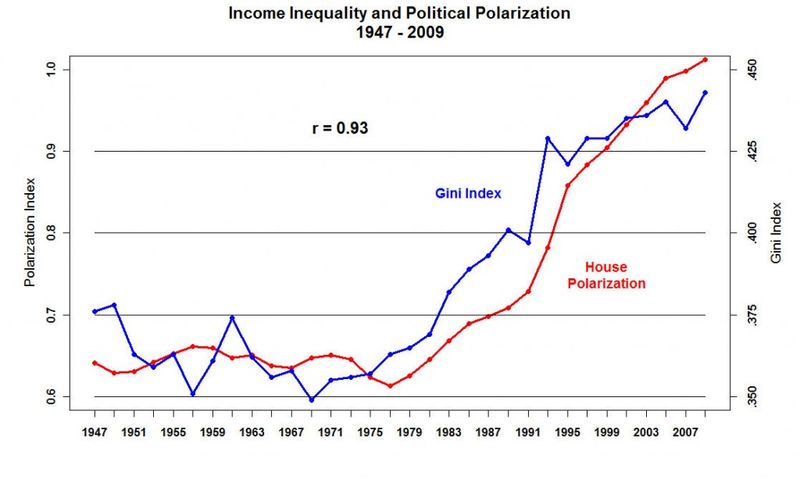
Inequality and polarization go hand in hand, leaving our country divided and unable to deal with important issues, like the deficit or the environment. The unfortunate Citizens United decision gave corporations the same freedom of political speech protection enjoyed by individuals, leading to unlimited corporate money in politics, pushing America further from democracy to plutocracy.

Hope?

Stiglitz offered a few thin rays of hope. Can America change course? Well, it has in the past. As in our own age, inequality was high in the gilded age of the late 1800's and again in the 1920's. Also notably, both eras were marked by financial crises. In each of these cases, America changed course to temper the worst of the excess.

In more recent times, Brazil has succeeded in swimming against the tide of rising inequality. Stiglitz credits the Brazilian elite for realizing that a more level playing field would lead to a more stable and functional society. Will their American counterparts realize that the collapse of the middle class is not in anyone's best interest?

More

Monday, June 11, 2012

Capital stock vs. GDP per person

From the Economist of May 26, Special report: China's economy, Investment: Prudence without a purpose; Misinvestment is a bigger problem than overinvestment.

That's a nice linear relationship shown in all the Asian countries. What explains the lower slope of the US - high GDP but lower growth in capital stock? Is the US underinvesting / overconsuming? Much of the growth over this time in America was the rise of the finance industry, which is not capital intensive, whereas the Asian countries are more weighted towards manufacturing.

I wonder what the breakdown is of each economy in terms of manufacturing vs. services.

Saturday, March 10, 2012

Leveraging moral hazard

The Economist, hypothesizing an unattainable federalized Euro-Fed, says, "If you were sitting down with a blank sheet of paper, you would advise the euro zone to complement its one-size-fits-all monetary policy by pooling sovereignty and creating new institutions, [...among other things...] a bail-out fund could ensure that large European banks were not at the mercy of their vulnerable sovereign borrowers."

That's a touching show of sympathy for the creditors. And, looking at how the US fared with its massive intervention and how scary things were looking in Europe for a while there, you might conclude that bail-outs are the lesser evil. We'll have to wait and see how this looks in 5 or 10 years.

Greece asks Angela Merkel and Nicolas Sarkozy for a hundred billion Euros as concerned and inexplicably naked investment bankers look on.

Some say the big mistake the US made was letting Lehman Brothers go under. Some say the mistake was in the inconsistency of how Bear Stearns was handled compared to Lehman.

Whether an investment bank or a small sunny country with lots of islands, "too big to fail" applies either way. Maybe Greece isn't, but Spain might be and Italy even more so. While Greece and Spain both have long histories of default on debt (according to my dedicated research staff), Italy does not.

What's needed is a mechanism, an orderly well-defined processes, to handle failure of large systemically connected entities, whether they are corporations or governments.

Defaults happen. It's only common sense that we should have a means for resolving default, while minimizing damage and preventing problems from spreading to weaker neighboring nodes in the densely connected social network of finance.

That shouldn't mean protecting creditors or borrowers from the consequences of poor decisions.

The so-called "voluntary" hair cuts for holders of greek bonds, an attempt to avoid triggering credit default swaps, appear to have failed. But, what if they hadn't? Or pressure from some country whose investment banks had underwritten CDS's had influenced the terms of a bailout? Some speculate that was back story behind Timothy Geithner's trip to Europe in December.

In that context, credit default swaps are a device for leveraging moral hazard.

Credit-default swaps on Greece cover $3.16 billion of debt, down from about $6 billion last year, according to the Depository Trust & Clearing Corp. That compares with a swaps payout of $5.2 billion on Lehman Brothers Holdings Inc. in 2008. The actual payout on Greece will be “much smaller” than the net amount reported by DTCC, Pickel said. A gross $68.9 billion of contracts were outstanding as of March 2 before accounting for offsetting trades.

Amazingly, after the AIG debacle, there's still no disclosure requirements for CDS exposure, so it's hard to know the extent to which US banks have sold CDS on European Debt and net exposure is even harder to guess. It looks like some of that exposure got unwound in to past few months. You can bet, a lot of it ended up in the laps of taxpayers, just like last go 'round.

Monday, February 27, 2012

Alex Tabarrok - Launching the Innovation Renaissance

I'm something of a junky for the EconTalk podcast. On a recent episode, Alex Tabarrok and host Russ Roberts both of George Mason University had a conversation about Tabarrok's book Launching the Innovation Renaissance. Tabarrok argues that innovation in the United States is being held back by patent law, the educational system, and immigration policies.

Tabarrok's recommendations to increase innovation and productivity:

  • prune back the patent system
  • pay teachers better and in return demand better more accountable teachers - a more competitive, flexible, and open educational system
  • focus education more on the STEM (science, technology, engineering, math) fields
  • enable high-skilled immigration
  • cut back on regulation
  • invest in research and infrastructure - productive assets rather than welfare and warfare.

On intellectual property, he nails the problem head on:

Where you are building on previous ideas, standing on the shoulders of giants, then what you have to recognize is that previous intellectual property has veto power on new intellectual property. Intellectual property has two sides. Yes, it's an incentive to innovate. But it's also a cost. When you are building on previous intellectual property, it's a cost of innovation. Patents can be a cost of innovation as well as an incentive.

Tabarrok suggests a graduated system with 3-year, 15-year and 20-year patents and a narrowing of scope of the patents that are granted with the specific aim of allowing for cumulative innovation.

On education, Tabarrok worries that universities have become a status good - a consumption good, rather than a productive investment, especially for fields outside of the STEM fields, science, technology, engineering, math.

Computers are exploding, the Internet is exploding. And yet we graduated more students in computer science 25 years ago than we do today. [...] the same thing is true in mathematics and statistics, in chemical engineering.

How you fix that, I'm not sure. Subsidize those fields more and fluffier fields less? An engineering student pays 3k in tuition, but it costs 20k to study English Literature? That seems a little crass. On the other hand, I studied in a building paid for with Microsoft money. So, even if governments find it difficult to play favorites, industry can certainly sponsor fields selectively.

The one place where I might part ways with both Tabarrok and Roberts is the belief in deregulation.

One of the big influences on my thinking has been Mancur Olson's Rise and Decline of Nations. What Mancur Olson talks about is this accretion of interest groups over time. Everyone is trying to divide that pie up more and more in their favor, and it slows down decision-making.

It's not that I doubt the accretion of special interests. It's all around us. But, is deregulation the cure to that? Maybe they're right; regulation can certainly be a tool of rent-seekers.

Could we even build the Hoover Dam today? Technologically, yes. But politically could we have the will to do it? There would be so many environmental groups, so many lawyers, so many state and local governments, so many veto players.

But, deregulation can work out for worse, too. Take away Glass-Stegal, you get too-big-to-fail. Too much deregulation is an invitation to criminality and incompetence. Think of liar loans or the BP gulf oil spill. My own suspicion is that tilted rules are no good, no rules are no good, and sensible, well thought out, fairly and firmly enforced rules are really difficult and prone to failure, but are still the only serious option.

Venture capital comes up, briefly, in the context of it being stifled by Sarbanes-Oxley. I would pay a lot of attention to that system. Big companies are doing less basic research. In the pharmaceuticals industry, for instance, a big chunk of the early stage R&D has been outsourced from big-pharma to venture funded biotech. You might say, venture capital is the silver lining on this gilded age we're in. VC and corporate research budgets skew largely toward product development rather than basic research. Even so, we'd better keep the venture system healthy or we'll have a lot less privately funded research of any kind going on.

It might be the case that the dilema the US finds itself in regarding innovation is a counterpart to what gets called the middle-income trap. In the high-income trap, the pie is so big that there's an enormous temptation to try to get a slightly bigger slice for ones-self. The relative effort of that is less then trying to grow an already huge pie bigger and the potential rents are juicy. Once that kind of thinking sets in, the social contract erodes and people loose faith.

I hope people in high places read Tabarrok's book. I hope they don't pay too much attention to the deregulation bit, and instead take seriously the challenging job of designing rules that make true innovation more rewarding than gaming the system.

More

Monday, August 1, 2011

Making the patent system even worse

The economist explains the state of the US patent system like this:

At a time when our future affluence depends so heavily on innovation, we have drifted toward a patent regime that not only fails to fulfill its justifying function, to incentivise innovation, but actively impedes innovation. We rarely directly confront the effects of this immense waste of resources and brainpower and the attendant retardation of the pace of discovery, but it affect us all the same. It makes us all poorer and helps keep us stuck in the great stagnation.

Congress is in the process of passing a "first-to-file system". It's hard to see this as anything but a gift to big corporations. Writing in Foreign Policy, Clyde Prestowitz calls the Americans Invent act, "...a bill likely to cut the heart out of our innovative, entrepreneurial culture...". Even the pro-patent group American Innovators for patent reform says,

American Innovators for Patent Reform is opposed to the America Invents Act and we urge the House of Representatives to draft an entirely new law that truly addresses what needs to be reformed. The America Invents Act was crafted by lobbyists for the large corporations that are notorious infringers of patents!

...and...

Canada made the switch to first-to-file in 1989, and a 2009 study from researchers at Canada’s McGill University’s Department of Economics found that the change “failed to stimulate Canadian R&D efforts” and “skewed the ownership structure of patented inventions towards large corporations, away from independent inventors and small businesses.

It looks like the US patent system is about to become even more screwed up.

Nice work as usual, congress.

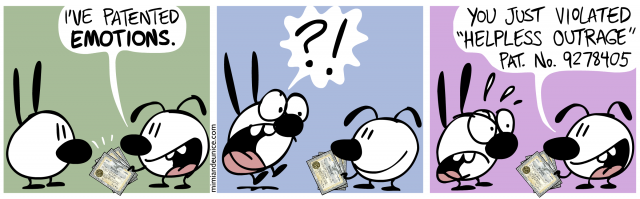
BTW, Mimi & Eunice is a work of genius

More links

Tuesday, March 22, 2011

Why the West Rules--for Now

Ian Morris draws on 50,000 years of history, archeology, and the methods of social science, to make sense of when, how, and why the paths of development differed in the East and West—and what this portends for the 21st century.

Stanford history professor Ian Morris put out a book this past October called Why the West Rules--for Now: The Patterns of History, and What They Reveal About the Future.

His answer to that question is not unlike Jared Diamond's excellent Guns Germs and Steel. The general trajectory of human societies is dictated by biology and sociology. The differences in their success is a matter of geography. But, the development of societies and technology periodically changes our relationship with geography.

Agriculture started in about 6 places around the world with favorable geography and climate. The invention of irrigation suddenly meant that you could grow crops in places where they formerly wouldn't grow. This theme repeats itself through the growth and decline of empires up to the invention of oceangoing ships and guns. Geography drives the development of societies and the development of societies then changes the meaning of geography.

Put together oceangoing ships and working guns and this is a very powerful package. The ships allow you to cross the oceans. The guns allow you to shoot the people you meet on the other side. This is great for everybody who's got them. ...it changes the meaning of geography once again.

The same process is still at work bringing about a shift of wealth and power from west to east. Whether that happens smoothly or not or whether it even matters by the time it's complete... those are open questions.

Morris sees the near future as "a giant race between, on the one hand, something like the singularity that Ray Kurzweil talks about, and on the other hand, some kind of nightfall scenario, where we trigger a set of changes that we simply can't control, and we are looking at a collapse of civilization on a scale that has never been seen before in history."

His factors of collapse are all too familiar:

  • migration
  • state failure
  • famine
  • epidemic
  • climate change

Wednesday, October 6, 2010

Will India's growth outpace China's?

The Economist's cover this week makes the claim that India's growth will outpace China's. India will be experiencing the demographic wave that other asian countries have ridden to prosperity in which a high percentage of the population falls within working age. Prevalence of English is an extra bonus. Further, India's democracy and entrepreneurial culture give it a flexibility unmatched by China's state dominated economy.

The conventional wisdom is that India's boom in the service sector is leaving a big chunk of the population stranded in poverty. This is because high skilled jobs like engineering or medicine -- even moderately skilled jobs in call centers -- require education and therefore are available largely to the children of the established middle class. In many countries, manufacturing has been the traditional stepping-stone out of subsistence agriculture. For example, a chinese factory girl might be the daughter of farming peasants from the countryside. These missing bottom rungs of the ladder have resulted in rising inequality. Amartya Sen warned that India risks becoming "half California and half sub-Saharan Africa".

Also working against India is it's crappy infrastructure and low literacy rates, 66% vs China's 93%. India's primary schools perform poorly and, the world-class IIT schools notwithstanding, its university system is undersized. The result is a chronic shortage of skilled workers. And business dealings involving land, natural resources and government contracts are riddled with corruption.

On India's cacophonous democracy, they quote a western banker as waying, "It's much easier to deal with the well-understood 'org chart' of China Inc than the freewheeling chaos of India.", which probably says a lot about western bankers.

I'd love to see India, with all it's contradictions, bust out and rival China. Based on Indian multinationals like Tata or Infosys, or the "frugal innovations" like $2000 cars, you might believe it possible. Whether the "freewheeling chaos" of democracy can function in a country of 1 billion; whether democracy is compatible with productivity; whether India can get its act together; those are some serious open questions. I hope the answer is yes.

Wednesday, September 1, 2010

Let the Bush tax cuts expire

Has the Wall Street Journal gone totally right wing nutballs or has it always been that way? A recent article on the expiration of the Bush tax cuts gives cause for concern.

In the summer of 2007, Rupert Murdoch prevailed upon the Bancroft family and sucked the WSJ into the media empire of News Corp. Murdoch's other properties include Fox News and the New York Post, neither of which are exactly monuments to journalistic integrity. As a very occasional reader, I can't say whether or how much the WSJ has changed since.

In the weekend edition of August 28, 2010 an unsigned editorial titled The $31 Billion Revenue Fantasy complains about the plan to let the Bush tax cuts expire. They make the claim that the Bush tax cuts were not a windfall for the rich. After the particularly piercing argument "Yada, yada, yada," (really, they said that), they throw up a bunch of numbers. It's not that surprising to find a sermon to the anti-tax faithful in the WSJ. But, the totally bogus and deceptive line of argument they use has a real Fox News ring to it. For example:

The IRS data show that in 2003 those with incomes above $200,000 paid $313 billion in income tax. By 2007 they paid $610 billion. When the recession hit, the payments fell to $537 billion in 2008. But even accounting for that decline, payments by the rich were still 65% higher five years after the rate cut that was supposedly a giveaway to the rich. The share of federal income taxes paid by the $200,000-a-year club was 42% in 2003 but 52% in 2008. (The IRS doesn't adjust these annual numbers for inflation.)

Inflation is only one reason why these numbers are not very meaningful. According to CPI numbers, 100 2003-dollars is about 117 2008 dollars. So, even if incomes only track inflation the pool of 200k-plus tax-payers grew. Also at the same time, the economy was expanding (and bubbles growing in housing and finance), which also lifts people into the higher income bracket. Tax receipts at all levels go up with the economy. Tax receipts from higher brackets go up more. Finally, high-income earners (for example those already over the 200k line) saw their incomes increase at a rate greater than the economy as a whole, thus paying more taxes.

These numbers are completely consistent with the story that the rich got richer while being taxed at a lower rate. As the New York Times put it:

Though tax cuts for the rich were bigger than those for other groups, the wealthiest families paid a bigger share of total taxes. That is because their incomes have climbed far more rapidly, and the gap between rich and poor has widened in the last several years.

- NYT “Tax Cuts Offer Most for Very Rich”

In 2003, 450 economists signed a statement (Economists’ statement opposing the Bush tax cuts (2003)) opposing the Bush tax cuts on the grounds that they would fail as a growth stimulus, increase inequality and worsen the budget outlook. Even Alan Greenspan thinks these tax cuts should expire as do former Treasury Secretaries Robert Rubin and Paul O'Neill.

The real question the editorial is trying to address is what degree of progressivity do we want in our tax system. Should those who have benefited most, in turn, support the system most? That's a fair and legitimate question. As economist Russ Roberts puts it, “Should we be more like France or less like France?”

What disappoints me about the WSJ article is this: Shouldn't the readers of the WSJ - educated businessmen, rather than tea-party loonies - be able to think this through soberly and logically? Given the audience of the WSJ, we're left with the scary conclusion that many of the wealthy are lying to themselves to justify their own sense of entitlement. Either that, or they're trying to arm themselves with deceitful and self-serving arguments to manipulate those less savvy than themselves.

There are common features to be found in several species of voodoo economics from the Laffer curve and trickle-down economics to "starving the beast" to the claim that letting the Bush tax cuts expire would stifle the recovery. Numerical quackery obscures policy that always seems to favor the rich at the expense of the common good.

What about what's good for the country? Shouldn't the country's business elites have a few ounces of patriotic blood in their veins? And might that lead to pursuit of goals that are good for America as a whole; strategies that grow the pie for everyone rather than tactics for capturing an ever bigger slice?

Related stuff

Wednesday, March 17, 2010

Joseph Stiglitz

Notes on: Joseph Stiglitz: The Economics of Information, an interview at The Asia Society from February of 2008.

Balance of global power is shifting due to:

  • rise of china and india
  • financial crisis
  • US debt

International organizations designed around the post WWII power structure are out of date and failing due to lack of legitimacy. True of the World Bank, IMF, and G8. Advocates the rule of law between nations and points out that the invasion of Iraq was a violation of international law.

US foreign policy often made for the benefit of campaign donors. Intellectual property rights deals made in secret undemocratically that favor narrow interests in the US. Much of foreign aid is also part of a global military strategy rather than truly for purposes of aid.

Why is China, a non-democracy, growing faster than India, a democracy? Stiglitz claimed that China allows more participation. (really?) China is investing heavily in Africa.

Under what conditions does Adam Smith's invisible hand work? In other words, are markets efficient always or under specific conditions? The financial crisis seems to be a case where the market failed. Market handle some situations poorly: imperfect information, externalities, public goods.

Median income in US lower today (2008) than 7 years ago and among males, lower than 30 years ago. Globalization is only one factor, but an easy target because the blame falls on outsiders. Social protection is not protectionist.

The stimulus package gives little directly to the unemployed, where it would be most effictive, due to being immediately spent. Stimulus should be spent on assets that will increase our future income.

GDP flawed measure. Median income can fall while GDP is rising if inequality is also rising. GDP neglects degradation of the environmental and depletion of resources. Switch from GNP to GDP politically motivated? (example: resource extraction).

Links

Monday, March 1, 2010

Great Powers: America and the World After Bush

The Carnegie Council hosts a great lecture series available as podcasts and videos. Military strategist Thomas P. M. Barnett (wikipedia) spoke on February 4, 2009 on his book, Great Powers: America and the World After Bush (audio, transcript).

Barnett's systems diagnostic view of the world

Barnett's basic argument is that globalization is a deliberate strategy on the part of the US to establish a world order in which developing nations can pursue export driven growth. America provides security, stability and a principle market, with the implicit agreement that trade surpluses would flow back into American debt instruments.

This american branded globalization consists of an international liberal trade order, collective security, high transaction network rates; most importantly, a competitive religious landscape. Stability operations are conducted to help establish order that advances U.S. interests and values. Great power war between the European powers or China-Japan-Korea-India has become unlikely. And there is a prevailing "minimal rule-set for connectivity to the global economy" that has moved about 3 billion out of poverty.

Historically, the American revolutionary war was, itself, a separatist guerilla action against the previous order. He credit's Alexander Hamilton's 1791 report on manufacturers as the first grand strategic document of the US. The early America was ruled by a succession of generals and revolutionaries and behaved in its early days much as Russia does now, with the exception that post-revolutionary America exported cotton rather than hydrocarbons. Slavery and ethnic cleansing are a part of America's history. Perhaps the industrialization of America during the robber baron days compares to China now.

Globalization was pursued as a continuation of the economic integration of the American wild west in the post-Civil War era. After the Civil War, through Theodore Roosevelt's time, regional economies were rapidly knit together into a continental economy. As the frontier was closed, economic integration with the outside world was the alternative to stagnation. (See Professor Frederick Jackson Turner's Frontier Thesis of 1893.)

Woodrow Wilson tries to establish an American order after WWI, but without sufficient military might is rebuffed by European powers. Finally, US kills colonialism at the end of WW2 (by Article 7 lend-lease agreement). Bretton Woods 1 established the World Bank, the IMF and the dollar as reserve currency and stabalized Europe during the cold war. Bretton Woods 2, after the demise of the gold standard in 1971 up until recently, underwrote the rise of Asia.

In this view, the US military has two roles - the Leviathan function, meaning the ability to fight big wars, and the system administrator function which maintains sufficient order for the functioning of the global economic network. During the cold war, the forces become overweighted in the Leviathan function to the extent that the integration skills honed on the American frontier deteriorated with visible consequences in Vietnam and Iraq. But, Iraq and Afghanistan are realigning and retraining a new generation of sys-admins.

America should be dedicated to encouraging democracy everywhere but we should be committed to forcing it nowhere.

We are in an age of integrating frontier markets. The major challenge over the next 20 years will be for the West and East to integrate the global south. The great divergence started by the industrial revolution then becomes the great convergence. A global middle class emerges. The high-trust environment of the West is now highly linked to the low-trust developing East. For access to raw materials, the low-trust East is integrating the no-trust countries of the bottom billion.

Economic integration comes before democracy and is better done by voluntary association than coercion. Wealth is the incentive to join the system. Democracy comes when countries are demographically middle class and middle aged. Markets bring this about by increasing income, creating a middle class and lowering birth rates.

To address this, the US military will realign toward system administration as the big war scenarios fade away. Taiwan will integrate Hong-Kong-style with China. Iran will become nuclear. America's tradition allies are demographically moribund, have declining defense budgets, and are increasingly unwilling to act geopolitically, while our new friends, the BRIC nations plus the Next 11 emerging economies, share the general goals of stability and economic interation.

Norman Angell, British philosopher, wrote the book The Great Illusion in 1911. It says: If the empires of the world in Europe went to war, they'd destroy each other and none of them would survive the process; so they're not going to do it because they're not that dumb. Turns out they were that dumb. Turns out they destroyed themselves. None of them are first-tier powers anymore as a result of that process. He gets the Nobel Peace Prize in 1933, sort of the consolation. [...People] say, "You're the second coming of Norman Angell." I say, "Damn straight, but I'm Norman Angell with nukes, and nukes change everything." They really do. And that's the good news.

Questions

Barnett played a role early in the GW Bush administration and supported the Iraq war. And I'm always suspicious when claims are made of a grand strategy after the fact. America is the result of globalization, not its cause. Globalization is the continuation of a process that goes back as far as civilization. This is a fascinating talk, regardless of how much you buy, but I was left with a few nagging questions.

  • What's the difference between this and the neocons?
  • What exactly does the system-administration function entail and is it best done by the military??
  • “America's empire is the first in human history to actually empower and enrich individuals” ...well, it's not the first to claim to do that.
  • Is it necessary for America to have the “World's biggest gun”? For one thing, I don't like paying for the world's biggest gun. For another, is our government vastly more trustworthy with such a thing than any other?
  • America, along with Europe, had a real chance to reorder the world after the cold war. What might have we done?

Notes:

  • BRIC = Brasil, Russia, India, China
  • Next 11 = Bangladesh, Egypt, Indonesia, Iran, Mexico, Nigeria, Pakistan, the Philippines, South Korea, Turkey, and Vietnam
  • The Monks of War
  • The Significance of the Frontier in American History, Frederick Jackson Turner

Tuesday, February 16, 2010

A Splendid Exchange - How Trade Shaped the World

A Splendid Exchange
How Trade Shaped the World
William J. Bernstein

Bernstein tells the story of trade from the dawn of civilization to the anti-globalization riots of 1999 in Seattle. Trade is a historial constant driving the wealth and military expansion of empires. This is a great story well told. The history of these trading empires explains so much about the modern world.

Chapters & notes

  1. Sumer

    Trade at the dawn of agriculture.

  2. The Straits of Trade

    Athenian trade routes through the Bosphorus. Access to trade drives the Peleponesian wars.

  3. Camels Perfumes and Prophets

    Camels, ships of the desert, and trade along the Arab peninsula - south to Yemen for incense, east to the Persian gulf for access to Asia through the Indian ocean.

  4. The Baghdad Canton Express

    Voyages of Marco Polo and Ibn Battuta to China. Indian ocean trade routes dominated by Middle Eastern Muslims and Jews. Zheng He leads Chinese naval expeditions into the Indian ocean.

  5. The Taste of Trade and the Captives of Trade

    Venice rises to power on mediterranean trade with the Muslim world. Asian spices and silk come to Europe only through trade with Muslims. Islam is governed through the unstable Mamluk system based on slave-soldiers. Venice trades in slaves from the Black Sea coast to the muslims. Crusades are tangled in efforts by the Venitians to protect this trade route from European rivals and to bypass muslim middlemen to access asian goods.

  6. The Disease of Trade

    The black plague follows trade routes through Europe and the Middle East.

  7. DaGama's Urge

    Vasco DaGama rounded the southern tip of Africa in 1498. The Portuguese established scattered trading colonies through which they brutally dominated the spice trade in the 16th century. Gao, Ceylon, Malacca, and the Moluccas and eventually Macau and Japan.

  8. A World Encompassed

    Worldwide trade routes established. Portuguese gradually give way to the even more brutal Dutch in the Indian Ocean.

  9. The Coming of Corporations

    The Dutch East Indies Company established monopoly on the spice trade. The Dutch had the most advanced financial markets of the day and invented of many of the tools of modern finance. Cotton, sugar, and tea rise as trade commodities as spices wane in profitability. The English are forced to favor free trade in order to compete.

  10. Transplants

    Boston tea party compared to an anti-globalization rally. England slowly turns toward peaceful free trade, to its advantage over the Dutch. Coffee. Cotton, fashion and the birth of mass marketing and consumer culture. Tea and sugar. Cane growing in the Carribean. The slave trade.

  11. The Triumph and Tragedy of Free Trade

    Breaking of the British East India Companies monopoly on the China trade. Canton, Macau, and Hong Kong. Cotton trade. Opium trade and wars with China. Henry Martyn, Adam Smith and David Ricardo. Comparative advantage. Corn laws - english landed aristocrats lobbied for tariffs on imported grain to their own advantage causing periodic hunger. The corn laws were repealed in 1846 after a long campaign led by Richard Cobden.

  12. What Henry Bessemer Wrought

    19th century. Copper mining and smelting in Jerome, AZ in 1882. American civil war free-trade south vs. protectionist north. Abe Lincoln's tariff. Invention of cheap steel. The displacement of sail powered shipping by steam over the 1800's. Rise of rail transport. Erie canal. Ice trade, leading to refridgerated shipping.

More...

A political economy

A recent piece in the Economist ( A new anthology of essays reconsiders Thomas Piketty’s “Capital” , May 20, 2107) ends with these words: ...