Showing posts with label intellectual property. Show all posts

Friday, September 4, 2015

A Very Short Introduction to Economics

Partha Dasgupta's A Very Short Introduction to Economics packs a lot into a few pages. Though incomplete and selective, it does a great job of guiding the reader through the intersections of economics and history, development, sociology and ecology.

The book is framed by contrasting the lives and prospects of two children, one in the suburban US, the other in rural Ethiopia, analyzing the factors of economic development that make the difference between communal subsistence agriculture and highly-specialized developed markets. Touching on a bit of game theory, Dasgupta shows how trust arises from mutual benefit and breaks down in the presence of uncertainty. Communities help to stabilize and safeguard trust, but in developed economies institutions increasingly ensure trust between parties who never meet.

Institutions like markets, courts and governments come easily to mind, but science and technology are two institutions of primary importance to economic development, a fact that Dasgupta crystallizes: "What Europe achieved during the Age of Enlightenment was [...] It created institutions that enabled the production, dissemination, and use of knowledge – in effect, the entire knowledge industry – to be transferred from small elites to the public at large, a transfer that so sharpened the analytic-empirical mode of reasoning that it became routine." (p99)

Science and technology are examined as institutions and economic inputs. The book sketches the unusual landscape of incentives that animate science in which highly speculative bets placed by research funders reward the successful scientist in terms of primacy and honors rather than cash and pay off for society in terms of knowledge as a public good. Dasgupta captures the tense relationship between science and technology like so:

"Increasingly though, the taste for those social contrivances has to compete against the pecuniary rewards available in Technology. If the pecuniary rewards increase – and they have increased greatly in recent years – the taste for the mores in Science becomes more and more of a luxury to the research worker. Science embodies a set of cultural values in need of constant protection from the threat posed by its rival, Technology. That threat has proved to be so real, that in recent decades the two institutions have begun to blur into each other. Scientists increasingly behave like technologists, while technologists enjoy both the pecuniary rewards of Technology and the medals and scrolls that Science has to offer." (p98)

Patents are covered but without mention of their central conflict, which the Economist expressed recently this way: "Patents are protected by governments because they are held to promote innovation. But there is plenty of evidence that they do not."

Sustainability is one of the most intractable issues of our time. Natural resources serve as economic inputs. Moreover, ecosystems provide economic services whose value escapes conventional economic analysis. Going further still, one may consider the entire human economy as a subsidiary of the earth's ecosystem. It'll strike some as a bit on the fringe to think of economics as a subsystem of nature or dwell on their deep similarities in terms of competition, adaptation, and exchanges of material and energy, but there's a very rich intellectual history behind these ideas.

Robert Frank calls Charles Darwin the father of economics as well as evolution. Turning that the other direction, economic concepts such as pareto optimality can inform the study of evolution. The central role of competition is explored in Geerat Vermeij's book, Nature: An Economic History. Organisms or organizations compete for resources, especially energy - the energy to go capture more resources. Looking at energy as the primary economic input goes at least as far back as 1921 to an address given by Frederick Soddy called Cartesian Economics. In terms of thermodynamics, it's the flow of free energy from the sun that drives local increases in order on our little planet. This is true in living systems as well as economic ones. On this topic, I'm looking forward to diving into Why Information Grows By Cesar Hidalgo. On the other hand, Mark Sagoff's essay, The Rise and Fall of Ecological Economics is critical of this line of thinking.

Those expecting A Very Short Introduction to Economics to follow a traditional economics curriculum will be disappointed. Many key economic concepts - opportunity cost, comparative advantage, elasticity are mentioned in passing or merely alluded to without naming them. Even supply and demand curves are relegated to a middle chapter. If you don't like the social-science side of economics, this is not the book for you. Also, the book is not mathy, which should be apparent from the concept of the VSI series.

One of my personal favorite ideas only gets a paragraph (p78) - Hayek's beautiful insight into the role of markets and price signals as parsimonious integrators of distributed information. Distributed computing teaches us is that coordination - transferring information, reaching agreement - is hard and expensive. The nifty trick of markets is that they tend towards efficient resource allocations while keeping down the cost of coordination. Of course, technology is good at spreading information around:

Despite the selectivity, it might be inevitable that I would like this little book since it connects several of my obsessive interests - economics, science and specifically life science. Both economics and biology are, at heart, the study of complex adaptive systems. Or in Venkatesh Rao's view, they are "soft technologies". Rao says, "Software has the same relationship to any specific sort of computing hardware as money does to coins or credit cards or writing to clay tablets and paper books." Likewise, I'd add, DNA codes living systems that run on the substrate of the cell.

Dasgupta clearly gets the perspective of the economy as a complex system made up of densely interconnected parts - households, firms and institutions - deeply linked to social and political systems and embedded in the natural world. With this encompassing breadth, the reader is well prepared to pick up a more traditional economics text with the big picture firmly in mind.

Saturday, February 23, 2013

The Politics of Data

“However objective data may be, interpretation is subjective, and so is our choice about which data to record in the first place. ... data, no matter how “big,” cannot perfectly represent life in all its complexity”

The Problem with Our Data Obsession, by Brian Bergstein writing in the MIT Technology Review

Privacy vs. transparency

There's been a flurry of news about openness and data.

Cartoon by Rayma.

David Brooks' New York Times pieces on The Philosophy of Data and What Data Can’t Do explore whether data can overcome human bias and what biases get introduced in the process, where to draw the line between data-driven decisions and organic judgment, when values, context and causation trump mere correlation. Flawed models helped bring about the 2008 financial crisis, but the underlying causes had more to do with deeply flawed incentives.

On one hand, data from social networks are making social science more scientific. On the other, do we want Facebook to make us more open and transparent to advertisers? I'm dreading 5 or 10 years from now when pictures of my kids will be used to advertise to me. The masters of click-data keep are sure to keep getting better at pushing our buttons.

The collection and exploitation of personal data remains a largely unregulated open frontier. But, on some fronts, policy is moving in a positive direction. The public was able to effect the demise of SOPA, but the special interests expect us to give up. The government is looking out for its own pocketbook when it mandates Open Access.

Open access in science

White House says government-funded research should be more public and has moved to expand public access to the results of federally funded research by directing that published results be made freely available to the public within one year of publication and requiring researchers to better manage digital data.

Open questions

What's needed is, a “rethinking [of] how our legal system affects technology, and how it allows crony capitalism to stifle innovation”.

There are trade-offs to be made: privacy against transparency; open access against proprietary business models. Can we trust what the data is telling us and how that knowledge will be used? Will the benefits will be gated and captured or open and distributed?

Thursday, December 6, 2012

Three Myths about Copyright Law

Just to prove that Lawrence Lessig is right, a GOP group released a shockingly sensible memo on copyright, then retracted it due to pressure from lobbyists. Now Derek Khanna, the staffer that wrote it has been given the boot.

Khanna’s three myths

  • the purpose of copyright is to compensate the creator of content
  • copyright is free market capitalism at work
  • the current copyright legal regime leads to the greatest innovation and productivity

To read

More on intellectual property

Monday, February 27, 2012

Alex Tabarrok - Launching the Innovation Renaissance

I'm something of a junky for the EconTalk podcast. On a recent episode, Alex Tabarrok and host Russ Roberts both of George Mason University had a conversation about Tabarrok's book Launching the Innovation Renaissance. Tabarrok argues that innovation in the United States is being held back by patent law, the educational system, and immigration policies.

Tabarrok's recommendations to increase innovation and productivity:

  • prune back the patent system
  • pay teachers better and in return demand better more accountable teachers - a more competitive, flexible, and open educational system
  • focus education more on the STEM (science, technology, engineering, math) fields
  • enable high-skilled immigration
  • cut back on regulation
  • invest in research and infrastructure - productive assets rather than welfare and warfare.

On intellectual property, he nails the problem head on:

Where you are building on previous ideas, standing on the shoulders of giants, then what you have to recognize is that previous intellectual property has veto power on new intellectual property. Intellectual property has two sides. Yes, it's an incentive to innovate. But it's also a cost. When you are building on previous intellectual property, it's a cost of innovation. Patents can be a cost of innovation as well as an incentive.

Tabarrok suggests a graduated system with 3-year, 15-year and 20-year patents and a narrowing of scope of the patents that are granted with the specific aim of allowing for cumulative innovation.

On education, Tabarrok worries that universities have become a status good - a consumption good, rather than a productive investment, especially for fields outside of the STEM fields, science, technology, engineering, math.

Computers are exploding, the Internet is exploding. And yet we graduated more students in computer science 25 years ago than we do today. [...] the same thing is true in mathematics and statistics, in chemical engineering.

How you fix that, I'm not sure. Subsidize those fields more and fluffier fields less? An engineering student pays 3k in tuition, but it costs 20k to study English Literature? That seems a little crass. On the other hand, I studied in a building paid for with Microsoft money. So, even if governments find it difficult to play favorites, industry can certainly sponsor fields selectively.

The one place where I might part ways with both Tabarrok and Roberts is the belief in deregulation.

One of the big influences on my thinking has been Mancur Olson's Rise and Decline of Nations. What Mancur Olson talks about is this accretion of interest groups over time. Everyone is trying to divide that pie up more and more in their favor, and it slows down decision-making.

It's not that I doubt the accretion of special interests. It's all around us. But, is deregulation the cure to that? Maybe they're right; regulation can certainly be a tool of rent-seekers.

Could we even build the Hoover Dam today? Technologically, yes. But politically could we have the will to do it? There would be so many environmental groups, so many lawyers, so many state and local governments, so many veto players.

But, deregulation can work out for worse, too. Take away Glass-Stegal, you get too-big-to-fail. Too much deregulation is an invitation to criminality and incompetence. Think of liar loans or the BP gulf oil spill. My own suspicion is that tilted rules are no good, no rules are no good, and sensible, well thought out, fairly and firmly enforced rules are really difficult and prone to failure, but are still the only serious option.

Venture capital comes up, briefly, in the context of it being stifled by Sarbanes-Oxley. I would pay a lot of attention to that system. Big companies are doing less basic research. In the pharmaceuticals industry, for instance, a big chunk of the early stage R&D has been outsourced from big-pharma to venture funded biotech. You might say, venture capital is the silver lining on this gilded age we're in. VC and corporate research budgets skew largely toward product development rather than basic research. Even so, we'd better keep the venture system healthy or we'll have a lot less privately funded research of any kind going on.

It might be the case that the dilema the US finds itself in regarding innovation is a counterpart to what gets called the middle-income trap. In the high-income trap, the pie is so big that there's an enormous temptation to try to get a slightly bigger slice for ones-self. The relative effort of that is less then trying to grow an already huge pie bigger and the potential rents are juicy. Once that kind of thinking sets in, the social contract erodes and people loose faith.

I hope people in high places read Tabarrok's book. I hope they don't pay too much attention to the deregulation bit, and instead take seriously the challenging job of designing rules that make true innovation more rewarding than gaming the system.

More

Sunday, December 18, 2011

Stop SOPA

In a matter of days, it looks likely that congress will pass SOPA (the Stop Online Piracy Act), another gift to special interest groups from motion picture and recording industry.

The bill targets sites like Sweden's The Pirate Bay, Hong Kong based MegaUpload or the Dutch site TorrentFreak requiring search engines, discussion forums, blogs and DNS providers to censor access to these types of sites prompting comparisons to China's great firewall.

The technical cluelessness on display in the congressional hearings is embarrassing, but, really, who expects anything different? Leading engineers have petitioned in opposition on the grounds that this legislation imposes serious burdens on infrastructure providers and probably won't even work.

How big a problem is this?

Technical issues aside, we should recognize that bootlegging movies or music is a fairly low-cost crime as far as society is concerned. Comparing it with illegal drugs, as The Economist does, is a joke when you think about lives wrecked by meth or crack or the ongoing drug war in Mexico. Piracy seems pretty benign next to the consequences of financial malfeasance in recent years, but now we're talking radical crazy talk.

The biggest consequence of piracy is that an artificial monopoly is less lucrative than it would otherwise be. Legal monopolies have a long history of abuse. They're a great way for politicians to give out favors and ask favors in return. In a textbook specimen of double-speak, any recognition of this economic and political reality is called sympathetic to piracy, something like being called a pinko in the McCarthy era.

A couple definitions

Rivalry is an economic concept describing whether the use of a good by one party precludes its use by another. The distinction being made here means that a million people could listen to Lady Gaga's latest tune at the same time. A million people could not ride in my car or live in my house. My house and car are rival goods. Songs are non-rival.

For every copyrighted work not pirated, how many would be purchased? My guess is that this ratio is low. I'm pretty sure nobody has convincingly shown otherwise. For the items not purchased, the utility of consuming them is lost, with no corresponding gain to the monopolist. This is called a dead weight loss, meaning some people could be made better off without making anyone else worse off, but we fail to do it. This loss is the music/movies/etc that wouldn't be enjoyed if they weren't pirated.

Willful ignorance of these simple but important ideas bugs me a lot more than bozo-grade technical knowledge.

Which is worse, the problem or the solution?

Now, it's important that creators of valuable intellectual property make a decent living. Few question that. What we're talking about is whether publishers should put up toll booths on the road between the consumer and the producer, and whether the government should enforce the use of these toll roads, when technology has made such choke points obsolete. Since distribution is now practically free, is it a good idea to create costly and ultimately ineffective legal barriers to replace the physical barrier that no longer exists?

Let's total up the costs. There's dead weight loss. There's a loss to innovation and culture which suffer when the interchange of ideas is impeded. There's the technical costs of implementing measures like SOPA, (and DRM and copy-protection before it), which tend to fall on paying customers.

To be fair, a partially market based means of valuing intellectual property and rewarding its creation is not to be dismissed lightly. Blocking access to download sites will result in some revenue trickling down to deserving artists. Too bad, no one speaks about the issue in terms of balancing benefits against costs.

The real problem

[The nightmarish SOPA hearings By Alexandra Petri, Washington Post]

It's shameful that congress is so eager to shill for corporations and their lobbyists rather than protect the interests of the people they are elected to serve.

Update:SOPA and it's sister PIPA (the PROTECT IP Act) have been temporarily shelved, thanks to an enormous public outcry and the opposition of Oregon Senator Ron Wyden. Clay Shirky sums it up, like so:

We should delight in the stand we’ve taken in favor of things like, say, notifications, and trials, and proof before censoring someone, but we should get ready to do it again next year, and the year after that. The risk now is not that SOPA will pass. The risk is that we’ll think we’ve won. We haven’t; they’ll be back. Get ready to have this fight again.

Monday, August 1, 2011

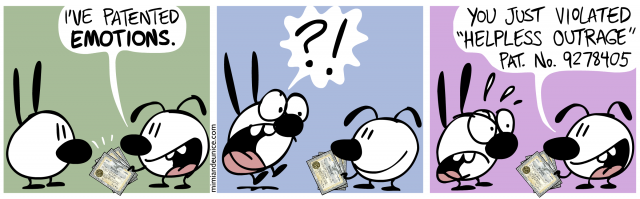
Making the patent system even worse

The economist explains the state of the US patent system like this:

At a time when our future affluence depends so heavily on innovation, we have drifted toward a patent regime that not only fails to fulfill its justifying function, to incentivise innovation, but actively impedes innovation. We rarely directly confront the effects of this immense waste of resources and brainpower and the attendant retardation of the pace of discovery, but it affect us all the same. It makes us all poorer and helps keep us stuck in the great stagnation.

Congress is in the process of passing a "first-to-file system". It's hard to see this as anything but a gift to big corporations. Writing in Foreign Policy, Clyde Prestowitz calls the Americans Invent act, "...a bill likely to cut the heart out of our innovative, entrepreneurial culture...". Even the pro-patent group American Innovators for patent reform says,

American Innovators for Patent Reform is opposed to the America Invents Act and we urge the House of Representatives to draft an entirely new law that truly addresses what needs to be reformed. The America Invents Act was crafted by lobbyists for the large corporations that are notorious infringers of patents!

...and...

Canada made the switch to first-to-file in 1989, and a 2009 study from researchers at Canada’s McGill University’s Department of Economics found that the change “failed to stimulate Canadian R&D efforts” and “skewed the ownership structure of patented inventions towards large corporations, away from independent inventors and small businesses.

It looks like the US patent system is about to become even more screwed up.

Nice work as usual, congress.

BTW, Mimi & Eunice is a work of genius

More links

Sunday, May 29, 2011

The PROTECT IP Act

The Protect IP Act (full text) enables the government and copyright holders to compel DNS providers, ISPs, search engines and advertisers to censor sites hosting copyright or trademark infringements. They're going to make linking to pirated material a crime.

Media companies want this because it's easier to go after the intermediaries, rather than the infringers, especially those outside the US. It's not that different from the Great Firewall of China.

This is the second attempt, the previous incarnation COICA having been introduced in September of last year. Senator Ron Wyden (D-Oregon), held up that legislation and is trying to do the same again. Cheers to Ron Wyden.

Larry Downes provides an excellent summary of the "full-scale war between content distributors and everyone else" in his Law of Disruption blog, including the property seizure tactics of the Department of Homeland Security's Immigration and Customers Enforcement division, a name straight out of Orwell.

The media industries, everyone agrees, are in the fight of their lives. These businesses rely for profitability on the controlled distribution of information goods whose individual copies have a marginal cost that keeps getting closer to zero.

The EFF has a couple articles on the PROTECT IP act and a petition.

One commenter asked, "Why is the attorney general wasting precious tax dollars enforcing corporate plutocracy?"

The real question

A lot changes when the costs of production and distribution are approaching zero. The question we should be asking is this: What still has value?

  • The creation itself - the skill, insight and artistic judgement necessary to make movies, music, or writing that doesn't suck.
  • The ability to sift through mountains of dreck to find the good stuff. The value of the filter goes way up in the new environment.
  • The community? A viable place to discuss. I'm pretty sure that the difference between Quora and You-Tube comments has value.

Legislating without a clear idea of what's valuable in the new environment will lead to useless and harmful laws that burden legitimate service providers while only slightly inconveniencing pirates - something like requiring every new car to come with a trunk full of horseshoes to protect the blacksmiths.

Thursday, February 17, 2011

Current intellectual property laws are blocking innovation

Groklaw has a good summary of the state of intellectual property law, The White House Asks: What's Blocking Innovation in America? - My Answer: IP Laws. It's best feature is a link to video of James Boyle's brilliant talk, Four Ways to Ruin a Technological Revolution. Boyle references Thomas Jefferson's writing on the topic: a letter to Isaac McPherson (here, here and here).

The invalidation of Myriad Genetics' BRCA gene patents last year gives some cause for hope. That decision is in appeal now. I hope the powers that be don't fail to appreciate the power of collaborative innovation.

I still mean to get around to reading Lawrence Lessig's The Future of Ideas, the fate of the commons in a connected world.

Friday, April 16, 2010

Gene patents are lame

Institute for Systems Biology's General Counsel, Cathryn Campbell, led a discussion on Myriad Genetic's BRCA gene patents. The ACLU and the Public Patent Foundation sued Myriad and Judge Robert Sweet of the Federal Court of the Southern District of New York ruled that "isolated DNA", which "represents the physical embodiment of biological information" is "unpatentable subject matter". Myriad will, of course, appeal.

Sadly, even if the ruling doesn't get overturned on appeal, the legal technicalities are such that rewording the patent claims might be enough to achieve the same effect. This particular ruling which hinged on whether the gene was a "product of nature" which is unpatentable or has been sufficiently transformed in the process of isolating the gene to warrant patent protection. It's encouraging to note that the judge recognized the unique information-carrying role of DNA.

Maybe a better question than whether a gene should be patentable is how do we encourage and reward invention and innovation such that we maximize the benefit to society? The exclusionary nature of patents (and copyrights) imposes a cost. What we get in exchange is a market mechanism to put a price on a given invention. Grants and prizes are another mechanism which avoid the costs of exclusion, but have other disadvantages. Mainly, whoever grants the award needs to be good at "picking winners", otherwise a money gets wasted.

Joseph Stiglitz and John Sulston, both nobel prize winners, write in a WSJ article titled The Case Against Gene Patents:

...we believe the patenting of human genes is wrong as a matter of science and as a matter of economics.
Proponents of gene patents argue that private companies will not engage in genetic research unless they have the economic incentives created by the patent system. We believe that a deeper understanding of the economics and science of innovation leads to exactly the opposite conclusion.

The Economist's Genes and patents: More harm than good?

In addition, the studies published this week suggest that granting exclusive rights over genes may be doing more harm than good. At the request of the American government, a team of researchers from Duke University, led by Robert Cook-Deegan, spent two years examining the country’s markets for genetic tests for diseases ranging from colon cancer to cystic fibrosis. The chief question they sought to answer is whether the intellectual property arrangements involved helped or hindered public access to those tests.
Their conclusion? That the rules hinder access.

What If The Very Theory That Underlies Why We Need Patents Is Wrong? cites Modeling a Paradigm Shift: From Producer Innovation to User and Open Collaborative Innovation, Baldwin and Von Hippel, on the rise of open and collaborative innovation and the fact that patents work against this type of innovation.

This result hinges on the fact that the innovative design itself is a non-rival good: each participant in a collaborative effort gets the value of the whole design, but incurs only a fraction of the design cost.

There's a really clear explanation of the economics of intellectual property in the first lecture or two of the UW's Information Technology & Public Policy, by Steve Maurer of UC Berkeley.

Lawrence Lessig's Coding Against Corruption explains the flaws in the legislative process that have gotten us into this predicament.

Friday, December 19, 2008

Digital rights management sucks

Cartoon by Rayma, originally in reference to Venezuelan politics.

The free market works when participants in the market are rewarded in proportion to the amount of good they contribute. With DRM this proposition is reversed. Society gains less benefit from a protected work, but the owner of the work gets more reward. (Or so they hope.) On top of that, copy protection mechanisms invariably provide a less useful product even to the paying customers. This helps explains why DRM is so universally reviled.

The crux of the problem is that traditional economics states that the price of goods in a competitive free market should approach the marginal cost to produce them. This works nicely for manufactured goods like cars, where the cost of capital, like factory equipment, can be amortized over large numbers of the manufactured product. For digital goods, the marginal cost approaches zero and the traditional economic model stops working.

Consider, also, the difference between rival and nonrival goods. To understand rival goods, imagine you want to build a house on a piece of empty land. Someone else wants to turn that land into a farm. Only one of those two uses can be accommodated. Either you or the farmer will have to outbid each the other for the use of the land. The theory goes that this competition will tend toward the most efficient use of scarce resources. But nonrival goods, for example information, can be put to an unlimited number of uses. Copying information is usually very easy compared to the effort of deriving the information in the first place, whether we're talking about a scientific theory or a piece of music. This creates a situation in which the most benefit is had by copying the information as widely as possible, yet it's very hard for the original creator to capture much of the wealth he has created. This is a very real dilemma, but the solution favored by intellectual property rights advocates - that of creating scarcity where no natural scarcity exists - sacrifices some fraction of the utility that would otherwise be gained in order to increase the portion that property holders can capture.

The publishing industry has set itself up as a middleman between the real content providers and consumers. They seek to use legislation to preserve this privileged position. A truly free-market approach would be to allow the middlemen to be made obsolete. This is what will happen eventually, the efforts of our toadying crony capitalist government notwithstanding.

We need to find market mechanisms that more closely align reward with contribution for the real content providers, the creative people. This is a tricky problem with no obvious solutions. For now, we'll have to put up with a lot of stupidity because so few people even clearly understand the problem.

A political economy

A recent piece in the Economist ( A new anthology of essays reconsiders Thomas Piketty’s “Capital” , May 20, 2107) ends with these words: ...