Sunday, November 18, 2012

Building reliable systems out of unreliable parts

The following rant was inspired by listening Econ Talk Garett Jones on Fisher, Debt, and Deflation while running.

There's a certain type of fundamentalism around the belief that government is necessarily dysfunctional. Reasoning that government is likely to spend and regulate unwisely, adherents advocate spending cuts and limitations on regulatory authority. The failures of defunded and hamstrung agencies then serve as further proof that the public sector can do little right. If further proof is needed, it's easy to find examples of state sponsored screw-ups.

These same individuals are often more credulous about the competence and probity of corporations. This faith seems undiminished by mountains of evidence in the events of recent years that it is misplaced. Businesses leveraged themselves to the hilt, made and traded risky loans with abandon, and felt almost obliged to keep dancing while the music kept playing.

It should be clear to all that an economic crisis of the magnitude of the great recession that began in 2008 couldn't have happened without substantial errors in both public policy and business decision making. Such as:

  • too much leverage
  • complexity and absence of regulation of derivatives
  • lax regulation of the traditional parts of the financial sector
  • perverse short-term incentives, moral hazard and lack of accountability on the part of the financial sector, especially investment banks
  • moral hazard and lack of accountability in government sponsored entities like Fanny Mae.
  • outright corruption (for example in loan origination) and regulatory agency shopping
  • policy encouraging home-ownership for high credit risk buyers.

Economists debate the degree to which stickiness of prices and wages magnify short-term blow-ups. One extra difficulty of a real-estate driven recession is that long-term contracts like mortgages are about as sticky as it gets.

Economic adjustment happens at different rates - from the millisecond response times of high-velocity algorithmic traders to the months it takes to sell a house or mop up after a bankruptcy. These mismatched rates present opportunities for arbitrage, but if they become severe enough, they can break established systems. Examples include collapses in overnight interbank lending during recent crises and the flash-crash of May of 2010.

Corporations are powerful engines of wealth creation. Countries without governments are not nice places. Both are flawed, but we'll have to stick with them, at least until we find better alternatives.

But, organizations built of humans are bound to be flawed, because they're built of flawed parts. History can be viewed as a series of attempts at engineering reliable systems from unreliable parts, with varying levels of success.

The political and economic dimensions of organizations, public or private, are inextricable. The rats are always trying to find a way in.

Sunday, October 28, 2012

Looting

In a great little interview on the Renegade Economist Talkshow, Tim O' Reilly mentions a 1993 paper by George Akerlof and Paul Romer called Looting: The Economic Underworld of Bankruptcy for Profit. The central idea is that there's a difference between creating wealth and extracting wealth from the economy.

The paper was the subject of a write-up in the NYTimes: The Looting of America’s Coffers.

Thursday, October 18, 2012

Inequality and Democratic Responsiveness

There has never been a democratic society in which citizens' influence over government policy was unrelated to their financial resources. In this sense, the difference between democracy and plutocracy is one of degree. But by this same token, a government that is democratic in form but is in practice only responsive to its most affluent citizens is a democracy in name only.
Most Americans think that public officials don't care much about the preferences of "people like me." Sadly, the results presented above suggest they may be right. Whether or not elected officials and other decision makers "care" about middle-class Americans, influence over actual policy outcomes appears to be reserved almost exclusively for those at the top of the income distribution.
Inequality and Democratic Responsiveness:
Who Gets What They Want from Government?
Martin Gilens
Politics Department, Princeton University

Years ago, I came across a paper about welfare. Written in the context of the Clinton era welfare reforms, the paper acknowledged the perverse incentives and dependency that accompany welfare for the low end of the income distribution. It went on to talk about welfare for the wealthy. This, it explained, is much more pernicious, in that the wealthy have greater means to influence policy, influence they use to divert further resources to themselves.

Every now and then, I try to find that piece again because it really helped open my eyes. The quotation above was the closest I could come, this time.

Friday, July 20, 2012

A revolution in higher education

In Lessons My Father Taught Me About How to Live on a Dangerous Planet, David Rothkopf recounts his father's narrow escape from Nazi occupied Austria to later become a professor of telecommunications and education at Columbia University.

“His response to the ravages to which he had been exposed was to focus on education, and specifically on understanding how people learned.”

This echoes a recent interview with Computer Science pioneer, and hero of mine, Alan Key.

“...the thing that traumatized me occurred a couple years later, when I found an old copy of Life magazine that had the Margaret Bourke-White photos from Buchenwald. This was in the 1940s — no TV, living on a farm. That's when I realized that adults were dangerous. Like, really dangerous. I forgot about those pictures for a few years, but I had nightmares. But I had forgotten where the images came from. Seven or eight years later, I started getting memories back in snatches, and I went back and found the magazine. That probably was the turning point that changed my entire attitude toward life. It was responsible for getting me interested in education. My interest in education is unglamorous. I don't have an enormous desire to help children, but I have an enormous desire to create better adults.”

It looks like something really important is happening in higher education. Open online courses are disrupting the lock high-cost exclusive universities have on elite education. Sebastian Thrun talks about "democratizing higher eduction". In her New York Times essay, Daphne Koller quotes Nelson Mandela: “Education is the most powerful weapon which you can use to change the world.”

The senior Rothkopf dedicated his studies to the power of technology to remake education, delivering knowledge to people everywhere, believing that the greatness of nations is measured by “how we invest in our classrooms and our laboratories and in the minds and futures of our children.”

Saturday, June 23, 2012

It isn't blasphemous to exit the Euro

Sometimes I think I'm too cynical. But if this exchange on Dr. "Doom" Nouriel Roubini's twitter feed is to be believed, I guess I'm not cynical enough.

Roubini also lists the threats to the world economy in the doom-alicious A Global Perfect Storm that risk making 2013 into an especially 'lucky' '13.

  • Synchronized slowdowns in economies of Europe, the US and China
  • Political transition in China and elections in the US
  • Continued political risk in the Middle East, especially concerning Iran
  • Monetary policy depleted and fiscal stimulus limited by already high debt

Update ...and right on queue, the WSJ opines on Berlusconi's Latest Clown Act Italy's former prime minister turns populist euroskeptic. Too bad he never delivered on promised reforms.

Saturday, June 16, 2012

The Price of Inequality

Nobel prize winning economist Joseph Stiglitz came to Seattle Town Hall this week to talk about a new book, The Price of Inequality. Here's the way I heard it.

US inequality

The US is the most unequal of all industrial nations as measured by Gini index. As much as Americans take pride in the equality of opportunity and social mobility offered by our country, that seems to be a thing of the past. While inequality is rising in wealthy countries around the world, it's rising faster here.

To quote the OECD: “The wealthiest Americans have collected the bulk of the past three decades’ income gains. The share of national income of the richest 1% more than doubled between 1980 and 2008: from 8% to 18%. The rising incomes of executives and finance professionals account for much of the rising share of top income recipients. Moreover, people who achieve such a high income status tend to stay there: only 25% drop out of the richest 1% in the US, compared to some 40% in Australia and Norway, for instance.”

Rent seeking

The greater wealth accumulating at the top is not due to greater contributions to society. Rent seeking, in the forms of outrageous executive salaries and bonuses, regulatory privilege, corporate welfare and transfers from the bottom to the top, explains much of the wealth of the top few percent. That's not to mention the 15% tax rate paid by the likes of Mitt Romney. As Warren Buffet says, “It's class warfare, and my class is winning.”

Rent seeking distorts the economy away from productive activity. Because the payoff is so high, the best and brightest rush eagerly from graduate school to the high-stakes increasingly zero sum sleazy gambling house that is the finance industry, forgoing useful arts like medicine or research.

Political disfunction

Some have propagated the idea that greater inequality leads to a more efficient economy and therefore greater wealth in total. But, how to explain the fact that several countries have less inequality and higher GDP and also higher quality of life. Looking at the lack of growth in median household income over the past thirty years, one must conclude that little is trickling down.

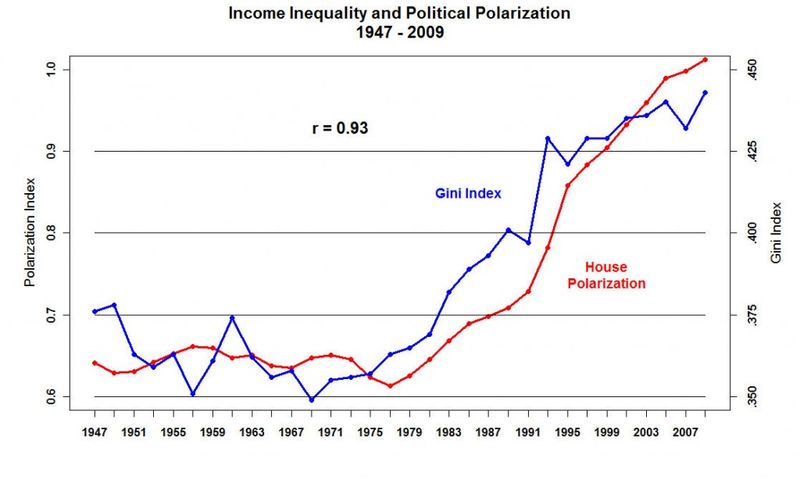
Inequality and polarization go hand in hand, leaving our country divided and unable to deal with important issues, like the deficit or the environment. The unfortunate Citizens United decision gave corporations the same freedom of political speech protection enjoyed by individuals, leading to unlimited corporate money in politics, pushing America further from democracy to plutocracy.

Hope?

Stiglitz offered a few thin rays of hope. Can America change course? Well, it has in the past. As in our own age, inequality was high in the gilded age of the late 1800's and again in the 1920's. Also notably, both eras were marked by financial crises. In each of these cases, America changed course to temper the worst of the excess.

In more recent times, Brazil has succeeded in swimming against the tide of rising inequality. Stiglitz credits the Brazilian elite for realizing that a more level playing field would lead to a more stable and functional society. Will their American counterparts realize that the collapse of the middle class is not in anyone's best interest?

More

Monday, June 11, 2012

Capital stock vs. GDP per person

From the Economist of May 26, Special report: China's economy, Investment: Prudence without a purpose; Misinvestment is a bigger problem than overinvestment.

That's a nice linear relationship shown in all the Asian countries. What explains the lower slope of the US - high GDP but lower growth in capital stock? Is the US underinvesting / overconsuming? Much of the growth over this time in America was the rise of the finance industry, which is not capital intensive, whereas the Asian countries are more weighted towards manufacturing.

I wonder what the breakdown is of each economy in terms of manufacturing vs. services.

A political economy

A recent piece in the Economist ( A new anthology of essays reconsiders Thomas Piketty’s “Capital” , May 20, 2107) ends with these words: ...