Friday, April 16, 2010

Gene patents are lame

Institute for Systems Biology's General Counsel, Cathryn Campbell, led a discussion on Myriad Genetic's BRCA gene patents. The ACLU and the Public Patent Foundation sued Myriad and Judge Robert Sweet of the Federal Court of the Southern District of New York ruled that "isolated DNA", which "represents the physical embodiment of biological information" is "unpatentable subject matter". Myriad will, of course, appeal.

Sadly, even if the ruling doesn't get overturned on appeal, the legal technicalities are such that rewording the patent claims might be enough to achieve the same effect. This particular ruling which hinged on whether the gene was a "product of nature" which is unpatentable or has been sufficiently transformed in the process of isolating the gene to warrant patent protection. It's encouraging to note that the judge recognized the unique information-carrying role of DNA.

Maybe a better question than whether a gene should be patentable is how do we encourage and reward invention and innovation such that we maximize the benefit to society? The exclusionary nature of patents (and copyrights) imposes a cost. What we get in exchange is a market mechanism to put a price on a given invention. Grants and prizes are another mechanism which avoid the costs of exclusion, but have other disadvantages. Mainly, whoever grants the award needs to be good at "picking winners", otherwise a money gets wasted.

Joseph Stiglitz and John Sulston, both nobel prize winners, write in a WSJ article titled The Case Against Gene Patents:

...we believe the patenting of human genes is wrong as a matter of science and as a matter of economics.
Proponents of gene patents argue that private companies will not engage in genetic research unless they have the economic incentives created by the patent system. We believe that a deeper understanding of the economics and science of innovation leads to exactly the opposite conclusion.

The Economist's Genes and patents: More harm than good?

In addition, the studies published this week suggest that granting exclusive rights over genes may be doing more harm than good. At the request of the American government, a team of researchers from Duke University, led by Robert Cook-Deegan, spent two years examining the country’s markets for genetic tests for diseases ranging from colon cancer to cystic fibrosis. The chief question they sought to answer is whether the intellectual property arrangements involved helped or hindered public access to those tests.
Their conclusion? That the rules hinder access.

What If The Very Theory That Underlies Why We Need Patents Is Wrong? cites Modeling a Paradigm Shift: From Producer Innovation to User and Open Collaborative Innovation, Baldwin and Von Hippel, on the rise of open and collaborative innovation and the fact that patents work against this type of innovation.

This result hinges on the fact that the innovative design itself is a non-rival good: each participant in a collaborative effort gets the value of the whole design, but incurs only a fraction of the design cost.

There's a really clear explanation of the economics of intellectual property in the first lecture or two of the UW's Information Technology & Public Policy, by Steve Maurer of UC Berkeley.

Lawrence Lessig's Coding Against Corruption explains the flaws in the legislative process that have gotten us into this predicament.


Saturday, March 27, 2010

The Future of Money

March's Wired Magazine has an interesting article called The Future of Money.

"...an army of engineers and entrepreneurs is ... hoping to do to the payment world what has already been done to the music, movie, and publishing businesses..."

Alternate payment systems like paypal or even sending payments through Twitter are on the rise. Also, alternate currencies Linden Dollars. The Economist likes to talk about payment systems through the cellular (not free) networks. (see Bling Nation for example)

I heard on an economics podcast that the government has loosened up the rules for issuing your own currency, something that was, up 'til recently, a jealously guarded prerogative of the Federal Reserve. It'll be interesting to see how all this interacts with the declining value of the good old green dollar bill.

Wednesday, March 17, 2010

Joseph Stiglitz

Notes on: Joseph Stiglitz: The Economics of Information, an interview at The Asia Society from February of 2008.

Balance of global power is shifting due to:

  • rise of china and india
  • financial crisis
  • US debt

International organizations designed around the post WWII power structure are out of date and failing due to lack of legitimacy. True of the World Bank, IMF, and G8. Advocates the rule of law between nations and points out that the invasion of Iraq was a violation of international law.

US foreign policy often made for the benefit of campaign donors. Intellectual property rights deals made in secret undemocratically that favor narrow interests in the US. Much of foreign aid is also part of a global military strategy rather than truly for purposes of aid.

Why is China, a non-democracy, growing faster than India, a democracy? Stiglitz claimed that China allows more participation. (really?) China is investing heavily in Africa.

Under what conditions does Adam Smith's invisible hand work? In other words, are markets efficient always or under specific conditions? The financial crisis seems to be a case where the market failed. Market handle some situations poorly: imperfect information, externalities, public goods.

Median income in US lower today (2008) than 7 years ago and among males, lower than 30 years ago. Globalization is only one factor, but an easy target because the blame falls on outsiders. Social protection is not protectionist.

The stimulus package gives little directly to the unemployed, where it would be most effictive, due to being immediately spent. Stimulus should be spent on assets that will increase our future income.

GDP flawed measure. Median income can fall while GDP is rising if inequality is also rising. GDP neglects degradation of the environmental and depletion of resources. Switch from GNP to GDP politically motivated? (example: resource extraction).

Links

Tuesday, March 16, 2010

Steward Brand: City Planet

Stewart Brand of the WELL and the Whole Earth Catalog wrote an interesting article back in 2006 called City Planet. He gave a lecture to the commonwealth club which I came across on daviding.wordpress.com. He gave a what appears to be the same talk compressed down to unintelligability at TED, but watch that for some of the visuals missing from the longer version.

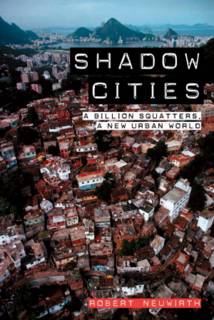
The bottom two billion are urbanizing, largely to squatter cities, to find jobs, freedom (especially for women), and education for their kids. He refers to Shadow Cities, by Robert Neuwirth, which I liked quite a bit, Shantaram by Gregory David Roberts, and C. K. Prahalad's The Fortune at the Bottom of the Pyramid.

See also:

Book Review: Shadow Cities, A Billion Squatters, a New Urban World

Here's a review of Robert Neuwirth's book Shadow Cities, A Billion Squatters, a New Urban World that I wrote a long time ago, but left to rot on my hard drive.

Imagine a third world shanty town and likely what you’ll think of is rampant crime and dire poverty; a place most of us would fear to tread. Robert Neuwirth, a reporter from New York City, spent two years living in four different squatter settlements. From the favellas of Rio de Janeiro to the corrugated metal shacks of Nairobi, continuing to Istanbul and Mumbai. His book examines the truth on the ground of shanty towns and the history of squatter communities.

In the shanties, Mr. Neuwirth does indeed find desperation and heavily armed drug gangs straight out of the film City of God. But, he also finds decent people struggling just to get by, facing complex economic and political obstacles with creativity and vitality.

Mr. Neuwirth meets hard-working people who have admirably provided for themselves rather than wait for government, society, or the official economy to provide for them. This, in fact, is the central theme of the book. For their independence and initiative, they are rewarded with perpetual risk of persecution and eviction.

The legal authorities are frequently no friend to the squatter, or the poor in general. In the town of Cuzco, Peru, unless things have changed since I was there, there is a statue outside the courthouse; a big black mountain lion, claws extended, fangs bared in an expression of menace. This is the image the Peruvian justice system presents to its people. In fact, the squatters of Neuwirth’s book fall frequently prey to the whims of government officials or real estate developers.

Favela Rocinha, Rio

The legal limbo in which squatter communities exist is perilous, but not without advantages. The illegality of the squatter’s property serves to some extent as protection from confiscation by the authorities whether for taxation, dept repayment, or plain corruption. And many squatter communities happily pirate electricity and other utilities with relative impunity while they bootstrap themselves into modernity. Cottage industries thrive in the tax and regulation free environment of the unofficial settlements.

Being a software developer myself, the parallels between the squatters rebellion against legal barriers and the debate around intellectual property practically leapt out at me. We are in a period of enclosure of intellectual property similar to the fencing in of the great open spaces. Moneyed interests with allies in the legal system seek exclusive ownership rights. It might not be stretching the analogy too far to think of a shanty town as an open source city.

The economics of the unofficial economy and the interaction of wealth, power, and property rights are interesting and complex. Neuwirth’s book makes something of a hands-on companion to the theories of economist Hernando de Soto. Anyone with an interest in these subjects or a curiosity about the way of life in another world will enjoy Mr. Neuwirth’s book.

The vibrancy and ingenuity that Mr. Neuwirth finds in the slums contrasts vividly with the sanitized homogeneity of suburban consumer culture. It takes only a bit of imagination on the part of the reader to summon the sights and smells of the shanties; to visualize the gulf that divides their world from ours and the humanity that unites us.

Links

A political economy

A recent piece in the Economist ( A new anthology of essays reconsiders Thomas Piketty’s “Capital” , May 20, 2107) ends with these words: ...